
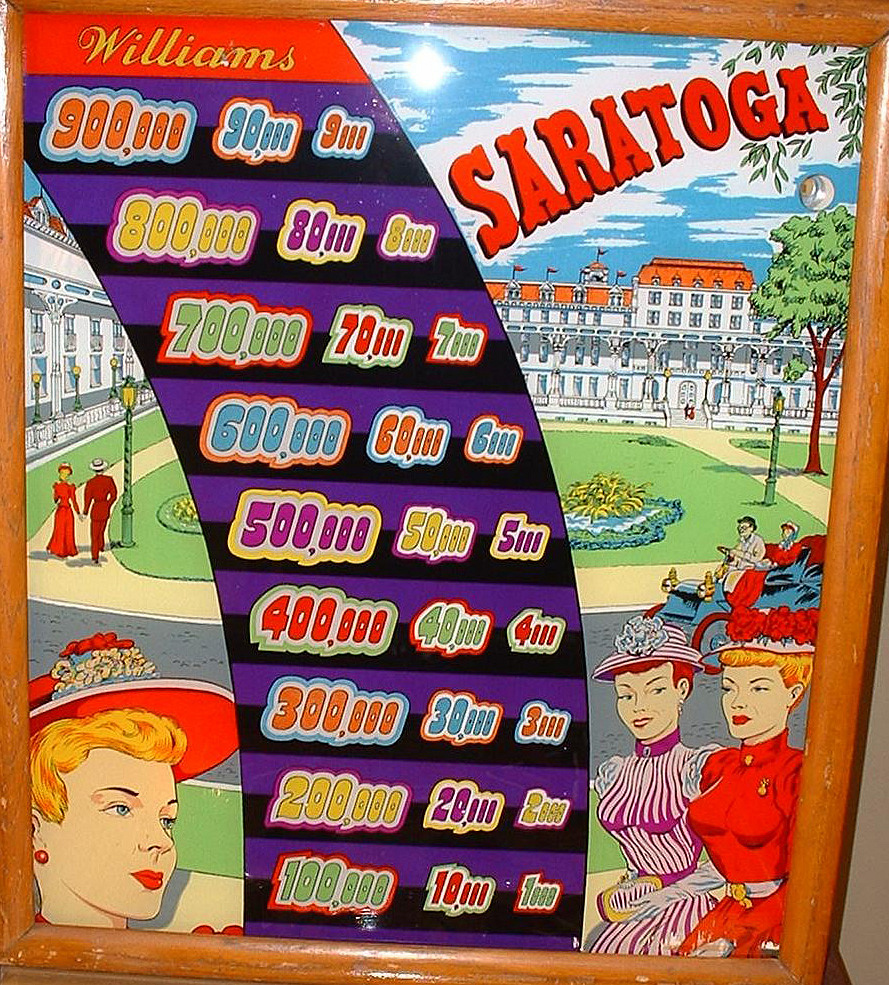
Saratoga, a 1948 release from Williams, stands as a quintessential artifact of the early post-war era, showcasing the foundational design sensibilities of industry pioneer Harry Williams. At a time when the industry was transitioning away from pure luck-based bagatelle-style games, this electromechanical title leans heavily into the minimalist, high-tension playfield layouts that defined the late 1940s. With art by the iconic George Molentin, the machine captures a distinct vintage aesthetic, relying on a simple two-flipper configuration to navigate a field populated by a mix of active pop bumpers and static passive bumpers.
The gameplay experience is defined by its brutal simplicity and the unforgiving nature of the two kick-out holes, which demand precision shooting rather than the chaotic, multi-ball-heavy play seen in later decades. Because the machine utilizes light-based scoring rather than mechanical reels, the visual feedback is immediate and stark, reflecting the rapid-fire pace expected of single-player electromechanical tables of the period. For the modern collector or tournament player, Saratoga serves as a masterclass in “less is more,” forcing you to rely on dead-pass control and accurate aim to keep the ball from rattling into the outlanes, as there is little room for error on such a sparse, unforgiving playfield.