
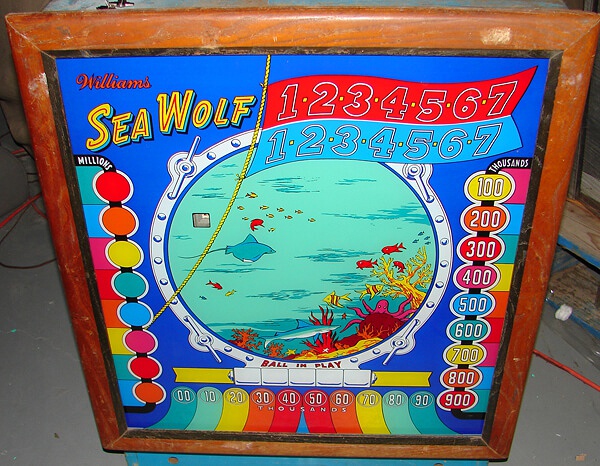
Sea Wolf, released by Williams in 1976, stands as a quintessential relic of the late electromechanical era, showcasing the tactical layout design of industry legend Harry Mabs. With artwork by George Molentin, the machine captures the high-stakes tension of maritime warfare, tasking players with navigating a dangerous seascape filled with submarines and naval vessels. The playfield is a dense, action-oriented grid featuring four flippers, three jet bumpers, and a trio of kick-out holes that demand precise aim to keep the ball in play while racking up points against the deep-sea opposition.
The mechanical heart of the game lies in its ten standup targets and a strategic gobble hole, which serve as the primary conduits for scoring. Unlike the wide-open playfields of the modern era, Sea Wolf rewards a disciplined, rhythmic approach; the layout is tight, forcing players to manage the ball through a gauntlet of passive bumpers and slingshots. Success on this table relies on mastering the geometry of the four flippers, which are essential for navigating the ball into the kick-out holes to trigger scoring sequences.
For those looking to conquer this nautical challenge, the key is to prioritize the standup targets to build your bonus multipliers before risking a shot into the gobble hole. Because the game utilizes light-based displays to track your progress, the visual feedback is immediate and frantic, mirroring the intensity of a sonar scan. Sea Wolf remains a masterclass in minimalist design, proving that even without digital screens or complex multiballs, a well-tuned electromechanical machine can offer a deep and punishingly rewarding experience for any vintage enthusiast.