
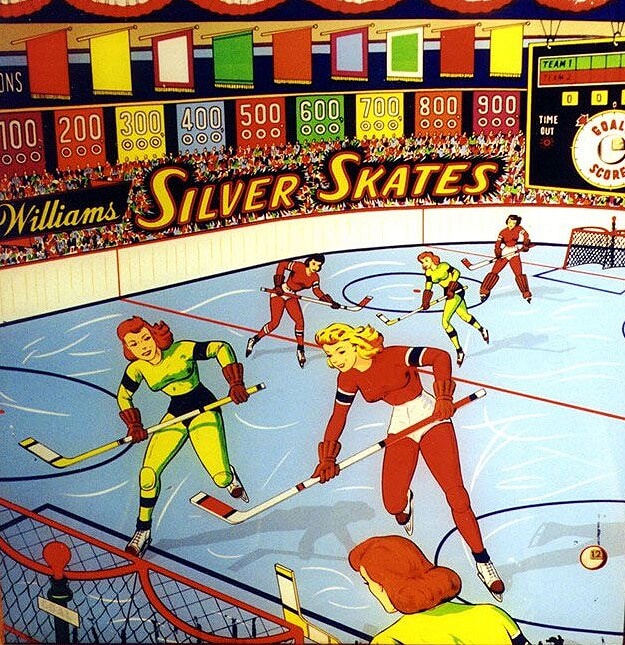
Silver Skates, a 1953 release from Williams, stands as a quintessential artifact of the early electromechanical era, masterminded by the legendary Harry Williams himself. With artwork by George Molentin, this hockey-themed title captures the frantic, slip-and-slide energy of the rink through a playfield design that feels surprisingly sparse yet deceptively punishing. Eschewing the complex mechanical toys of the modern era, the game relies on a classic layout of five trap holes and a mix of active pop bumpers and passive bumpers to dictate the flow of play.
The mechanical heart of Silver Skates lies in its four-flipper configuration—featuring both impulse and automatic flippers—which requires a delicate touch to navigate the puck-like ball toward the scoring zones. Because the playfield is devoid of the clutter seen in later decades, each shot to a trap hole demands precision and an understanding of the ball’s erratic gravity on the bare wood. It is a game of rhythm and momentum, where the absence of digital displays forces the player to focus entirely on the illuminated scoring lights, creating a raw, tactile experience that mirrors the simplicity of a backyard pond game.
For those looking to master this vintage piece, success hinges on controlling the ball’s trajectory into the various traps rather than relying on brute force. The passive bumpers act as unpredictable obstacles, often redirecting the ball into the outlanes if you aren’t prepared to nudge the cabinet. While it lacks the deep rule sets of the modern era, Silver Skates remains a masterclass in minimalist design, proving that Harry Williams could generate immense tension using nothing more than a few solenoids, some well-placed holes, and the relentless speed of a steel ball.