
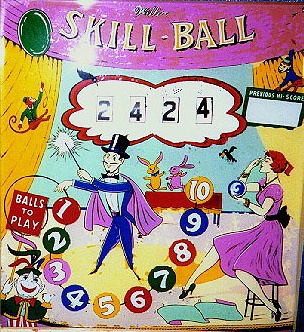
Skill-Ball, released by Williams in 1961, remains a quintessential example of Steve Kordek’s mastery over the early electromechanical era. Wrapped in a vibrant circus and carnival theme, this single-player machine strips pinball down to its most rhythmic, hypnotic components. With a limited production run of only 650 units, it stands today as a coveted piece of history for collectors who appreciate the tactile, analog charm of reel-based scoring and the frantic, high-stakes nature of “add-a-ball” gameplay.
The playfield layout is a masterclass in mid-century geometry, relying on a pair of classic flippers to navigate a landscape populated by three active pop bumpers and four passive bumpers that force unpredictable ricochets. The standout mechanical attraction is the swinging target, which demands precise timing to hit, while the two strategically placed gobble holes serve as both a blessing and a curse. Because this is an add-a-ball title, the primary objective is to keep the game alive by extending your session through clever shots, turning the machine into a test of endurance rather than just a race for a high score.
For those stepping up to the glass, the strategy centers on managing the chaos of the passive bumpers while keeping the ball away from the gobble holes unless the situation specifically rewards them. Kordek’s design philosophy shines through the simplicity of the layout; there are no complex modes or digital displays to distract you. Instead, you are left with the raw, rhythmic clatter of the score reels and the relentless tension of a ball that seems determined to find the drain. It is a pure, unadulterated carnival challenge that rewards steady nerves and a rhythmic touch.