
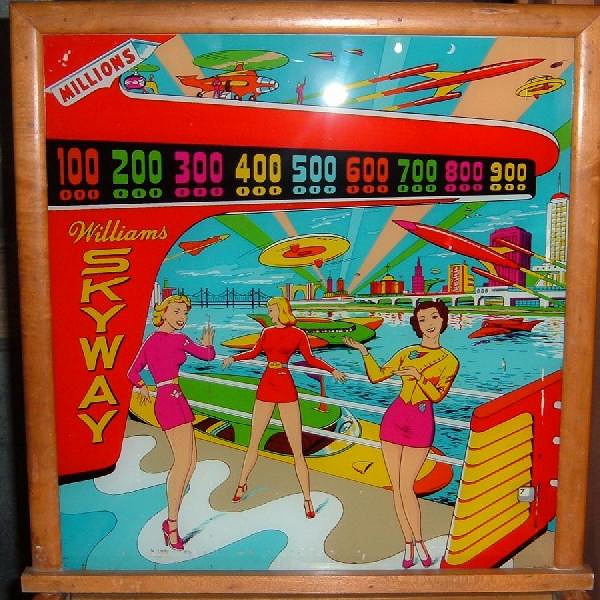
Skyway, a 1954 classic from Williams, stands as a quintessential relic of the mid-century Space Age aesthetic. Designed by the legendary Harry Williams and featuring the evocative, stylized artwork of George Molentin, the machine captures a bygone era of travel and cosmic optimism. It is a deceptively simple single-player EM machine that relies on a minimalist mechanical layout, centered around a lone impulse flipper that demands precision rather than brute force. With its sparse, clean playfield, the game emphasizes tactical accuracy over the chaotic multi-ball frenzies of later decades.
The playfield is a network of navigation, dominated by five strategically placed kick-out holes and two active ball kickers that keep the sphere in constant, unpredictable motion. Unlike modern machines that rely on complex ramps, Skyway tests the player’s ability to manage angles and speed, utilizing two pop bumpers and a classic gobble hole to challenge the player’s control. The scoring bumper adds a layer of escalating tension, rewarding those who can master the physics of the single-flipper setup.
For the vintage enthusiast, Skyway represents a masterclass in space-constrained design. Success on this table requires a disciplined approach to the kick-out holes; rather than chasing every light, the savvy player learns to anticipate the ball’s exit trajectory to set up the next shot. It is a beautiful, understated piece of arcade history—a reminder that in the golden age of pinball, a single, well-timed shot into a gobble hole was every bit as satisfying as the digital spectacles that would follow decades later.