
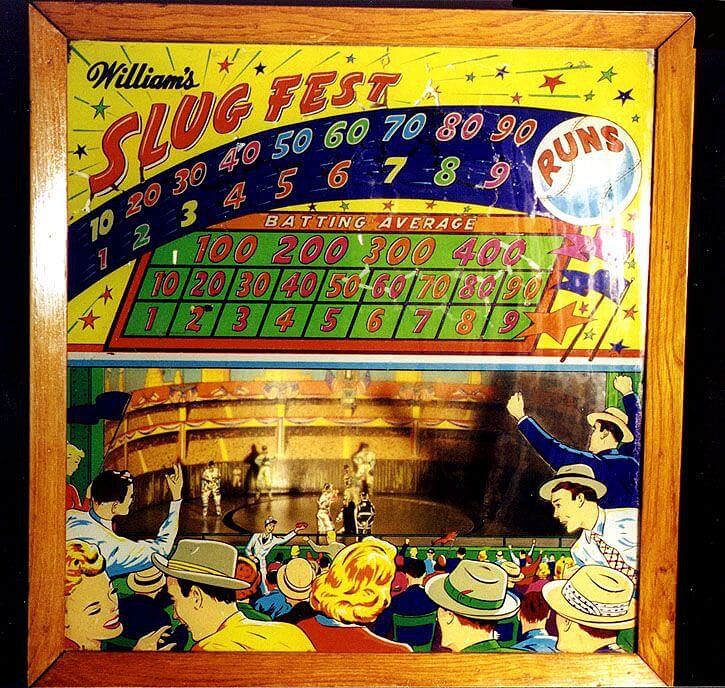
Slugfest is a classic Williams sports title that captures the grit and charm of mid-century baseball through an Electromechanical lens. Designed by Harry Mabs with iconic art from George Molentin, this 1952 release eschews the traditional playfield layout for a specialized experience focused on the diamond. Rather than relying on standard pinball objectives, the machine utilizes a mechanical backbox animation to simulate the ebb and flow of a ballgame, transforming the cabinet into a miniature stadium where the player acts as both batter and strategist.
The playfield is a unique layout defined by a trio of trap holes and a series of passive bumpers that mimic the chaotic movement of a baseball in play. Three pop bumpers provide the kinetic energy necessary to keep the action moving, while the two flippers demand precise timing to navigate the ball toward the scoring zones. Because the machine lacks the complex digital rule-sets of modern pins, the satisfaction comes from mastering the physics of the trap holes and maintaining control amidst the passive bumper clusters, which act as the “fielders” of this mechanical arena.
For the vintage enthusiast, Slugfest remains a standout example of early sports-themed innovation. Its strength lies in its simplicity; it doesn’t need a multi-ball mode or a complex ramp system to deliver a satisfying challenge. Success on the machine requires a rhythmic approach to the flippers, treating each shot like a swing at the plate to ensure the ball avoids the hazards and triggers the backbox scoring sequences. It is a quintessential piece of arcade history that proves even the oldest mechanical designs can still hold their own when the goal is pure, competitive fun.