
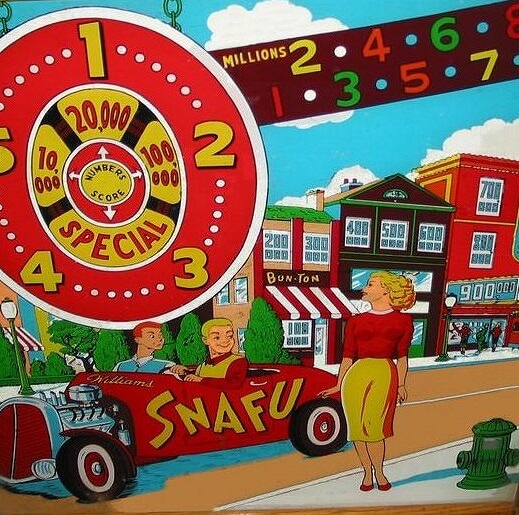
Snafu, a 1955 release from Williams, stands as a quintessential piece of mid-century electromechanical design. Penned by legendary designer Harry Mabs, the machine reflects a simpler, more kinetic era of arcade history where the focus rested squarely on precision and reflex. With George Molentin providing the aesthetic vision, the playfield is a study in minimalist engineering, utilizing a pair of flippers and two active pop bumpers to navigate a board populated by five passive bumpers that turn the game into a chaotic, high-stakes game of pinball billiards.
The mechanical layout is surprisingly sparse by modern standards, yet it offers a deceptively challenging experience. A single standup target serves as the primary objective, demanding accuracy amidst the frantic rebounds caused by the passive bumpers scattered across the playfield. Because the machine lacks the complex ball-saving features and multiball modes of later decades, every shot requires total commitment. It is a game of pure geometry; players must master the slingshots and the erratic paths created by the passive bumpers to keep the ball in play and maximize their score before it inevitably drains.
For those looking to conquer this classic, the key is spatial awareness. Because the passive bumpers act as unpredictable deflectors rather than scoring engines, the strategy involves controlling the ball’s momentum rather than fighting it. Successful players learn to anticipate the “snafu” effect—the tendency for the ball to ricochet into the outlanes after hitting the passive obstacles. By playing the angles off the slingshots and keeping the ball moving toward the center of the playfield, one can tame this vintage beast and climb the ranks of this high-scoring, single-player challenge.