
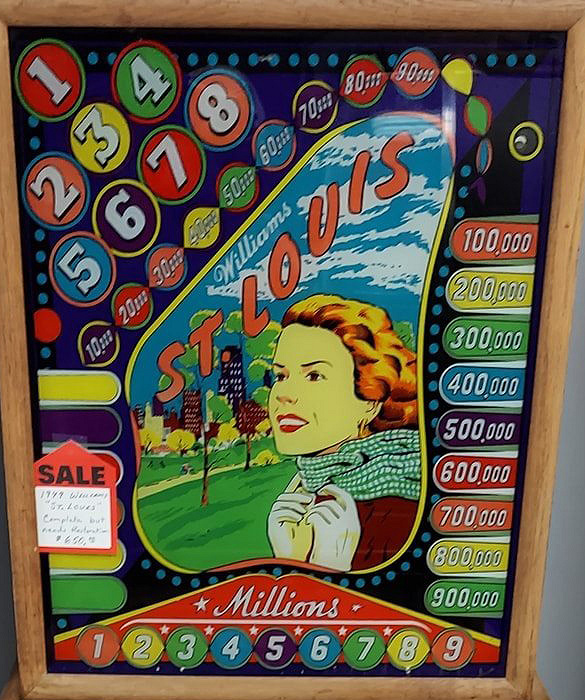
St. Louis, released by Williams during the golden age of electromechanical machines, stands as a quintessential artifact of mid-century arcade design. Conceived by the legendary Harry Williams and brought to life through the distinct, nostalgic aesthetic of artist George Molentin, the machine captures a bygone era where pinball was as much a social pastime as it was a test of reflexes. Eschewing the complex electronic displays and sprawling subways of modern cabinets, St. Louis relies on the tactile satisfaction of light-based scoring and the straightforward, rhythmic flow that defined the early Williams catalog.
The machine operates on a simple, honest premise: five balls for a single nickel. In an age of high-stakes multiballs and deep rule sets, St. Louis demands precision and patience. Without the crutch of deep mission stacks, the player’s focus is entirely on ball control and hitting target zones to rack up points on the illuminated light board. It is a minimalist experience that rewards the player for mastering the fundamentals of the flipper, offering a pure, unadulterated slice of Americana that feels just as challenging today as it did when it first graced a St. Louis storefront.