
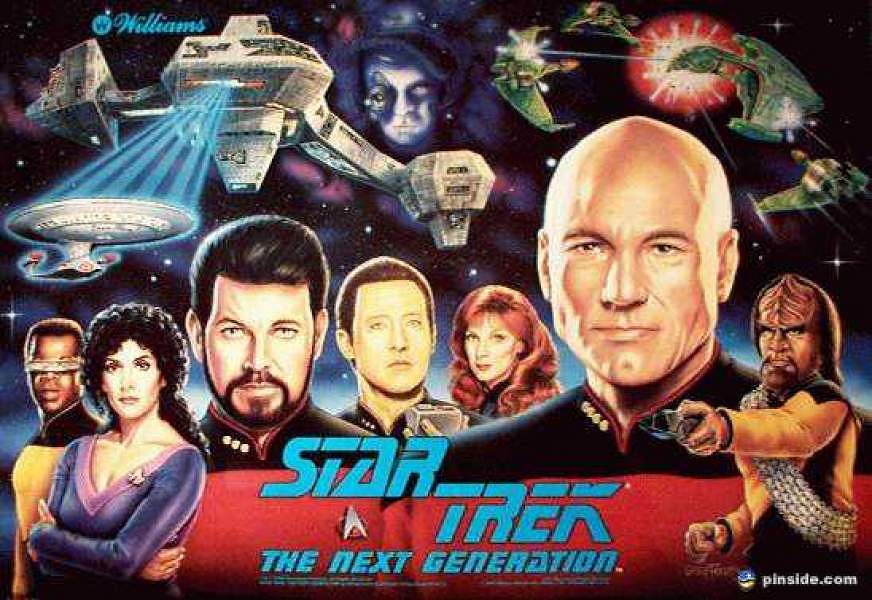
Williams’ Star Trek: The Next Generation, released in 1993 and designed by Steve Ritchie with Dwight Sullivan and Greg Freres, is a widebody epic and a jewel of the studio’s SuperPin series, sitting alongside Twilight Zone and Indiana Jones. Its unforgettable feature is a pair of rotating cannons mounted above the slingshots, fired by cabinet buttons to blast balls directly at targets across the playfield — a layer of aiming skill no other machine offered. Backed by genuine cast voice clips and the era’s largest pinball code, it became the last Williams machine ever to sell over 10,000 units and took the ACME award for best pinball of 1994.
The depth is staggering. You take on missions and modes, building toward the colossal Final Frontier wizard mode, where collecting sets of four artifacts pays a billion points apiece. The cannon shots are central to multiball, increasing the jackpot by ten million each time, so lining them up is everything. Combos rule the table — repeating the “Picard Maneuver” (left orbit to side ramp) and chaining the Alpha and Beta ramps build toward Explosive Millions worth up to fifty million a shot.
There’s a treasure trove of strategy and secrets, from guaranteeing multiball every game by choosing Light Lock and Light Holodeck off the plunge, to the hidden “Riker’s Poker” video mode, to the precise shuttle-simulation pattern that maximizes points. The cannons reward patience as much as aim: their values and the Super Jackpot light climb as you play, so a steady hand that lines up consistent cannon shots will always out-score a flailer. Even buying in an extra ball can land you on the leaderboard. Vast, fast, and brilliantly engineered, Star Trek: The Next Generation is Ritchie at his most ambitious — a deep-space masterpiece that has obsessed players for over three decades. Make it so.