
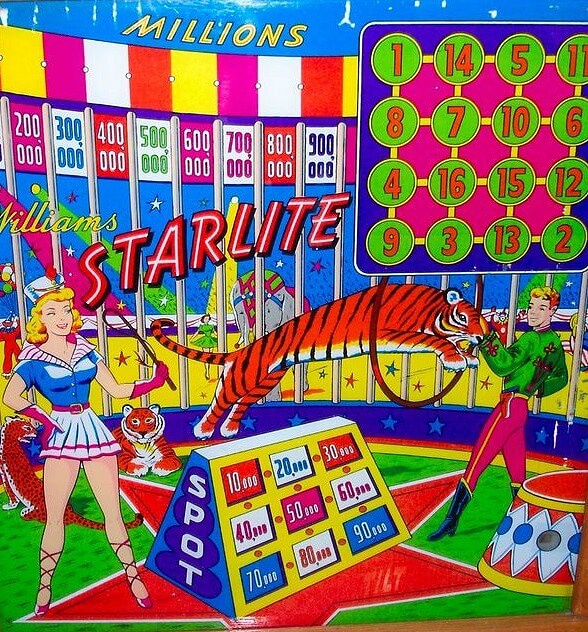
Starlite, released by Williams in 1953, serves as a quintessential time capsule from the golden age of electromechanical pinball. Designed by industry legends Harry Williams and Sam Stern, with iconic cabinet and playfield aesthetics rendered by George Molentin, this single-player machine leans heavily into the classic circus and carnival motifs that defined the era’s visual language. While modern machines boast deep rule sets and complex sub-systems, Starlite captures the raw, kinetic charm of mid-century arcade gaming, where the primary objective was purely about ball control and hitting high-scoring targets before the playfield drained.
The game is famously marketed under the banner of “5 balls for 5 cents,” a nostalgic reminder of when pinball was a literal nickel-and-dime thrill. Eschewing digital displays for the classic incandescent glow of lamp-based scoring, Starlite demands a rhythm-based approach to the flippers. Because the machine lacks the multi-ball chaos or deep mission modes found in contemporary hardware, success relies on mastering the geometry of the playfield to keep the ball in play while navigating the target layout. It remains a stark, elegant example of how the design team balanced simplicity with the high-stakes pressure of a limited ball count, making every shot count in a frantic, carnival-themed race against the inevitable drain.