
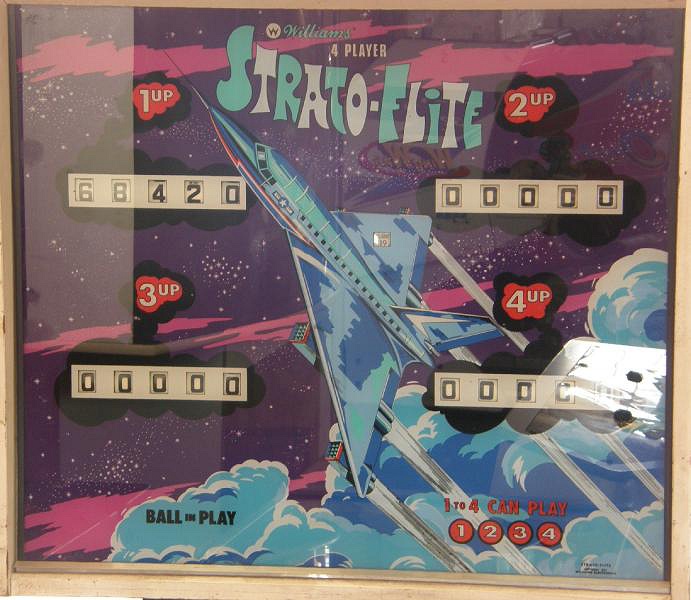
Strato-Flite, released by Williams in 1974, stands as a quintessential example of the mid-70s electro-mechanical era, bearing the distinct creative signatures of designer Norm Clark and artist Christian Marche. With an outer space theme that leans heavily into the retro-futuristic aesthetic of its time, the game utilizes a dense field of fifteen standup targets to create a high-stakes, target-heavy experience. Marche’s vibrant, unmistakable artwork wraps the cabinet and playfield in a cosmic atmosphere, turning this four-player machine into a test of precision rather than just raw power.
The mechanical layout is deceptively simple, relying on three pop bumpers and two slingshots to keep the ball in constant, erratic motion across the target-laden field. Success on Strato-Flite is entirely dependent on your ability to clear the specific banks of targets labeled A, B, C, and D. By systematically knocking down these sequences, players unlock escalating rewards, including double and triple bonuses that are essential for climbing the leaderboard. The inclusion of upper and lower ball return gates adds a layer of flow to the gameplay, preventing the ball from getting trapped in the outlanes too prematurely.
With nearly 6,000 units produced, Strato-Flite was a workhorse in the arcades of its day, and its longevity is a testament to the satisfying “clack” of its mechanical reels and the rewarding feedback of its target bank progression. It is a game that demands patience and accuracy; you aren’t just hitting targets for points, you are building a multiplier chain that keeps the tension high until the final ball drains. For those who appreciate the tactile, no-nonsense design philosophy of the Norm Clark era, this machine offers a challenging, space-age trek that remains a staple of the vintage pinball experience.