
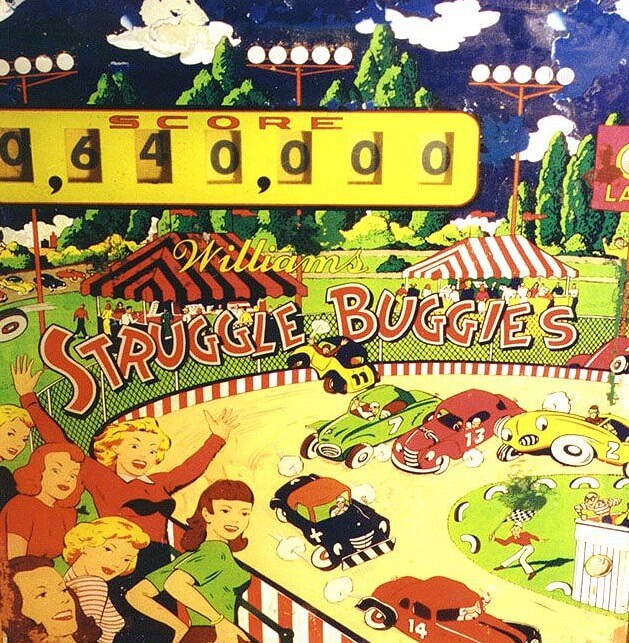
Struggle Buggies, released by Williams in 1953, stands as a quintessential relic of the early electromechanical era, capturing the raw, kinetic energy of mid-century auto racing. Designed by the legendary Harry Mabs with punchy, period-accurate artwork by George Molentin, this single-player machine strips pinball down to its most fundamental, aggressive mechanics. Eschewing the complex ramp structures and multiball modes of the modern age, the game challenges the player to navigate a dense, treacherous playfield where every bounce feels like a high-speed collision on a dirt track.
The layout is deceptively simple yet punishingly active, featuring two flippers that must contend with a chaotic swarm of seven passive bumpers and a pair of pop bumpers that turn the lower half of the table into a frantic pinball gauntlet. Success requires mastering the two strategically placed kick-out holes, which act as both temporary sanctuaries and potential point-multipliers. Because the game relies entirely on score reels, every successful shot into a kick-out hole provides that satisfying, tactile “click” of mechanical progress that remains the gold standard for vintage enthusiasts.
For those looking to dominate the leaderboards on this classic, the key is to prioritize ball control around the cluster of passive bumpers. Given the lack of modern ball-saving features, players must learn to nudge the cabinet aggressively to keep the ball from rattling into the outlanes after a wild bounce off the pop bumpers. It is a game of rhythm and reaction, embodying the spirit of early racing where the struggle to keep the machine running was just as vital as crossing the finish line. Struggle Buggies remains a testament to Mabs’ ability to create high-stakes tension with nothing more than a handful of switches and a pair of flippers.