
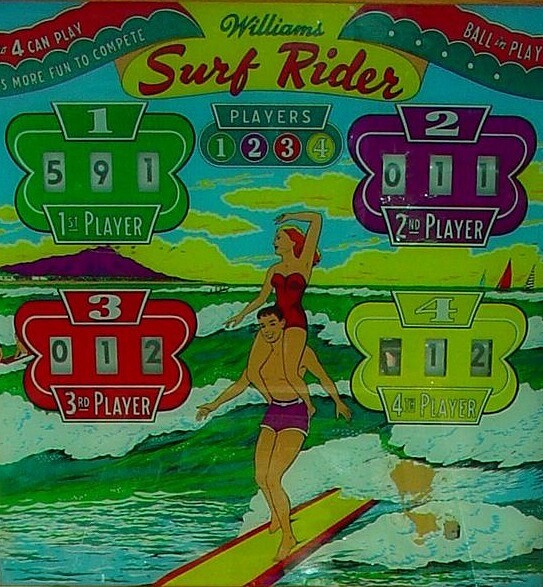
Surf Rider, a 1948 classic from Williams, stands as a quintessential artifact of the early electromechanical era, showcasing the foundational design sensibilities of Harry Williams himself. This four-player machine trades the complex, multi-layered playfields of the modern age for a focused, rhythmic experience centered on the carefree, sun-drenched aesthetic of mid-century surfing. With artwork by the legendary George Molentin, the cabinet and backglass radiate a nostalgic, recreational charm that captures the post-war enthusiasm for leisure and water sports, turning the simple act of hitting targets into a beach-bound mission.
The gameplay is defined by its straightforward, honest architecture, prioritizing precision and flow over the digital spectacle of later decades. Utilizing a five-ball count per player, the machine demands a disciplined approach, as every shot must be calculated without the benefit of modern ball-save mechanics or complex rule sets. The mechanical reel displays provide a tactile, satisfying feedback loop that defines the vintage arcade experience, rewarding the player with the unmistakable clatter of scoring updates.
For those looking to master this relic, the strategy is as clean as the playfield itself. Because the machine lacks the safety nets of contemporary pinball, success hinges on mastering the geometry of the slingshots and the predictability of the ball’s trajectory off the bumpers. It is an exercise in patience and classic aim, serving as a reminder that before the era of deep code and cinematic modes, the true thrill of pinball was found in the raw, physical interaction between the flipper and the ball. Surf Rider remains a beautiful example of how Williams defined the sport in its infancy, offering a serene, focused session that celebrates the pure joy of the game.