
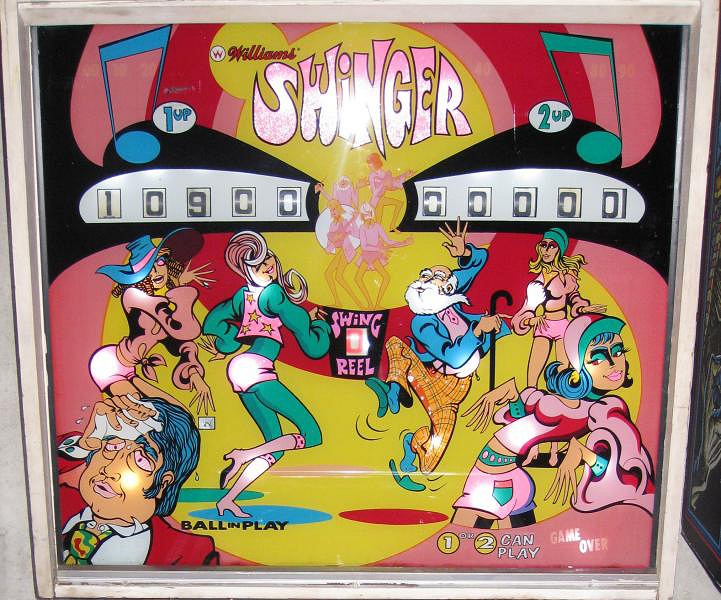
Swinger, released by Williams in 1963, stands as a quintessential piece of early sixties design from the legendary Norm Clark. With artwork by Christian Marche, the machine leans heavily into the era’s “dancing and singing” zeitgeist, offering a bright, rhythmic aesthetic that matches its snappy electromechanical gameplay. The playfield is dominated by a dense cluster of five pop bumpers that act as the heart of the scoring system, demanding precise nudging and control to keep the ball dancing in the action for as long as possible.
The mechanical soul of the game is its namesake swinging target, which provides a satisfying, rhythmic “thwack” that breaks up the standard target-shooting flow. To master the table, players should prioritize the upper standup targets, which serve to inflate the scoring potential of those central pop bumpers. Defensive play is just as vital; hitting the designated standup target to activate the left outlane kickback is essential for survival, while the right outlane features a clever return gate to keep your ball in play.
Strategic depth on Swinger is deceptively simple but rewarding. While navigating the various standup targets to build your score, keep a close eye on your ball count—the game offers a juicy triple bonus multiplier on your fifth and final ball, which can easily turn a respectable score into a high-water mark. With its unique up-post between the flippers and a focus on high-energy, bumper-heavy chaos, Swinger remains a charming, fast-paced example of the golden age of Williams EM design.