
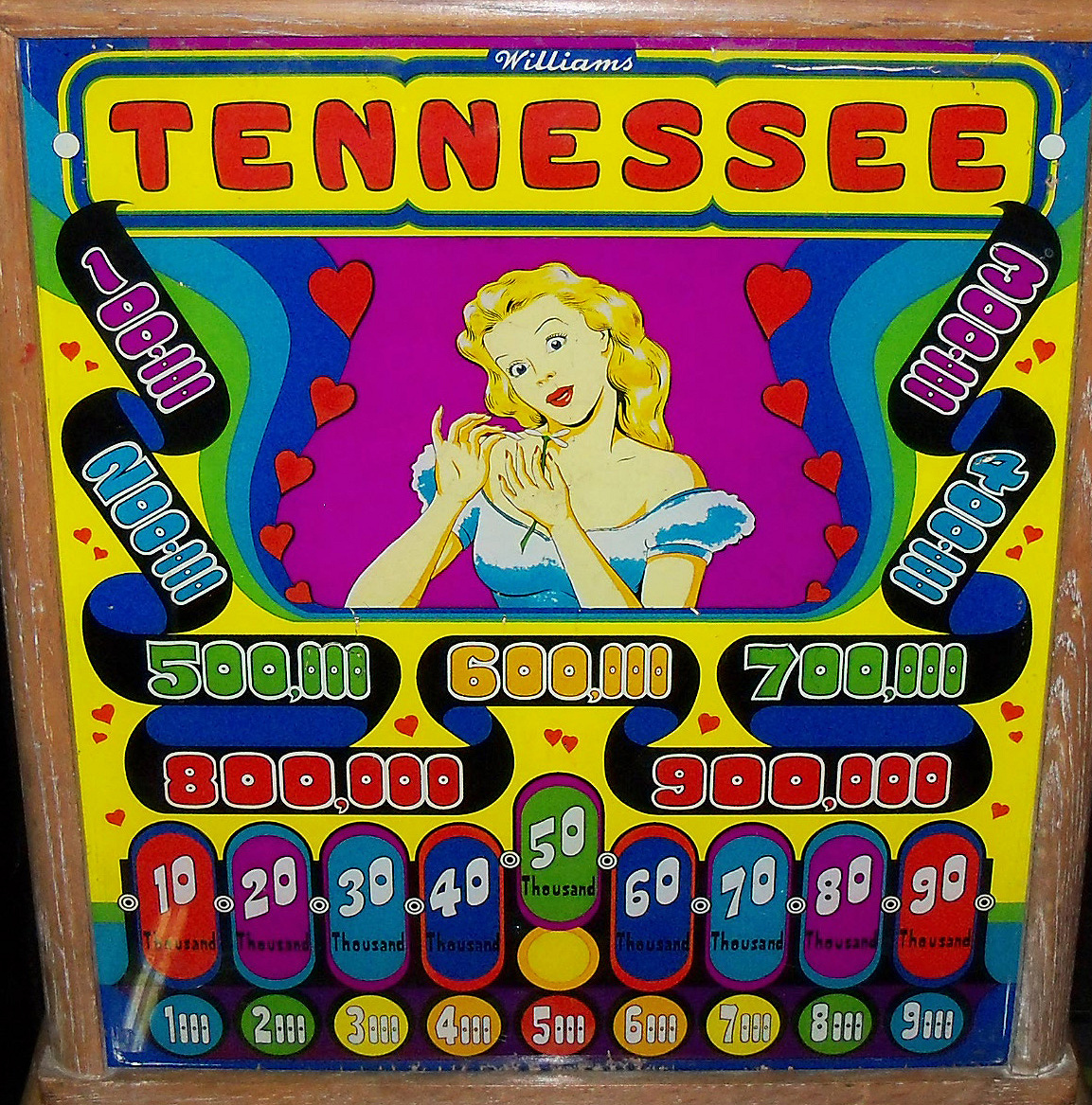
Tennessee, released by Williams in 1948, stands as a fascinating relic from the dawn of the flipper era, masterminded by the legendary Harry Williams himself. With art by the iconic George Molentin, this single-player electromechanical machine eschews the complex ramps and magnets of modern play for a raw, high-density field defined by its sheer number of interaction points. Featuring a layout dominated by an astonishing six flippers and ten passive bumpers, the table is a frantic test of ball control and reactive instinct that captures the sparse, charming aesthetic of mid-century Americana.
The gameplay experience is built entirely around the four strategically placed kick-out holes, which act as the primary engines for scoring and ball retention. Because the machine lacks the sophisticated digital feedback of later decades, success relies on mastering the geometry of the six flippers to navigate the crowded forest of passive bumpers that occupy the playfield. Players must be precise with their shots, as the kick-out holes provide the only reliable way to rack up points while managing the chaotic, unpredictable trajectories created by the bumper array.
For those looking to conquer this vintage classic, the key is to avoid “flipping blind” at the bumpers. Given the high density of obstacles, the most effective strategy involves using the lower flippers to intentionally cradle the ball, waiting for a clear path to one of the kick-out holes rather than simply batting the ball into the center of the playfield. Tennessee remains a testament to a time when pinball design focused on the visceral thrill of mechanical physics and player reflexes, proving that even without modern wizard modes, a well-balanced board can provide a challenging and rewarding experience.