
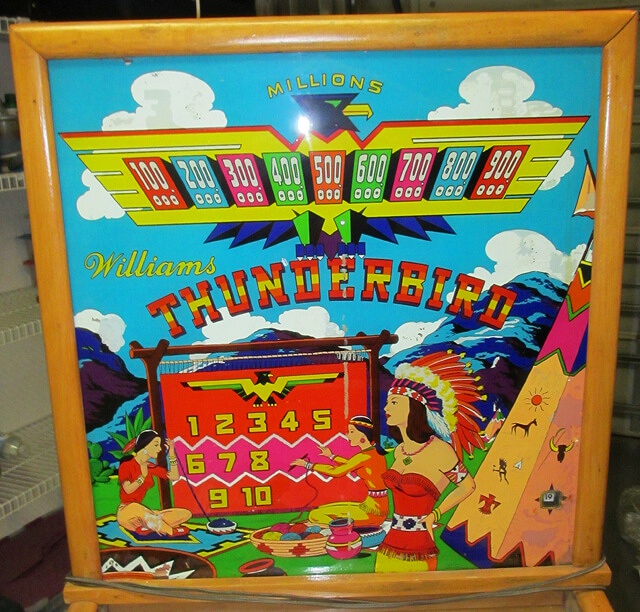
Thunderbird, a 1954 release from Williams, stands as a quintessential artifact of the early electro-mechanical era, masterminded by the legendary Harry Williams himself. With art by George Molentin, the machine leans heavily into its Native American theme, eschewing the flashy digital displays of modern tables for a classic, light-based scoring aesthetic. It is a game defined by its deliberate, rhythmic pace and an expansive playfield layout that feels remarkably crowded for its time, utilizing a sprawling network of eleven rollover buttons to reward precise ball control and navigation.
The mechanical heart of Thunderbird lies in its complex array of kick-out holes and ball kickers—four and three, respectively—which constantly keep the ball in motion, creating a chaotic, unpredictable flow that demands quick reflexes. Unlike the power-packed ramps of contemporary machines, Thunderbird relies on two impulse flippers to navigate a landscape dotted with three pop bumpers and two passive bumpers. The inclusion of a dedicated free-play hole adds a layer of high-stakes tension to every session, encouraging players to master the geometry of the table to earn those elusive extra credits. It is a fascinating study in mid-century design, offering a stripped-back, tactile experience that highlights the ingenious, purely mechanical ingenuity of the pioneers who built the foundation of the hobby.