
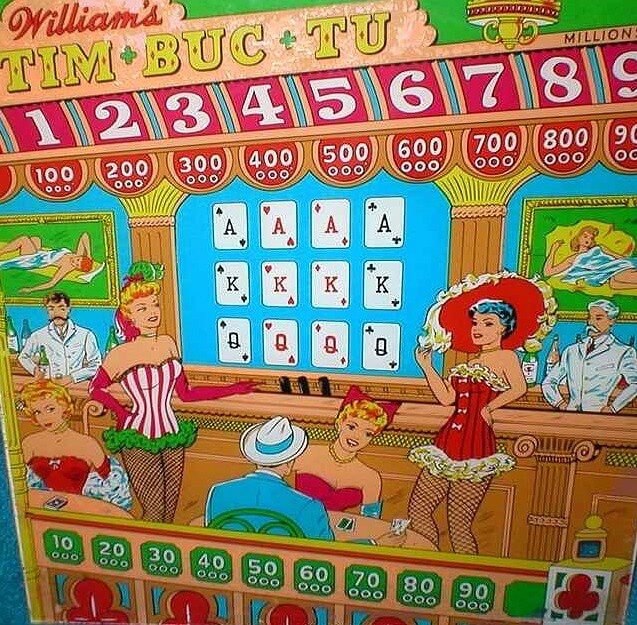
Tim-Buc-Tu, released by Williams in 1948, stands as a quintessential artifact from the golden age of electro-mechanical pinball. Designed by the legendary Harry Williams, this single-player title captures the minimalist, high-stakes charm that defined the post-war era of arcade entertainment. With art direction by George Molentin, the machine eschews the complex multi-level playfields of the modern era, opting instead for a streamlined, light-based scoring system that demands precision and spatial awareness rather than flashy, tech-heavy gimmicks.
The mechanical layout reflects a period where the challenge was found in the geometry of the playfield rather than the speed of a microprocessor. By stripping away the clutter, the machine forces the player to engage directly with the physics of the ball, utilizing the classic Williams architecture to test raw reflexes. Without the distraction of modern toys or deep rule sets, the game becomes a meditative pursuit of high scores, relying on the tactile satisfaction of vintage relay logic and the rhythmic, satisfying clack of a scoring unit.
For players looking to master this classic, the key lies in understanding the board’s inherent “dead zones.” Unlike today’s machines that offer a variety of modes to bail you out, Tim-Buc-Tu rewards the patient shooter who can control the ball’s momentum through the center of the playfield. Success requires a rhythmic approach to the flippers; rushing your shots on this vintage layout almost always leads to an early drain. It is a stark, honest test of skill that serves as a reminder of why Harry Williams is held in such high regard by historians of the craft.