
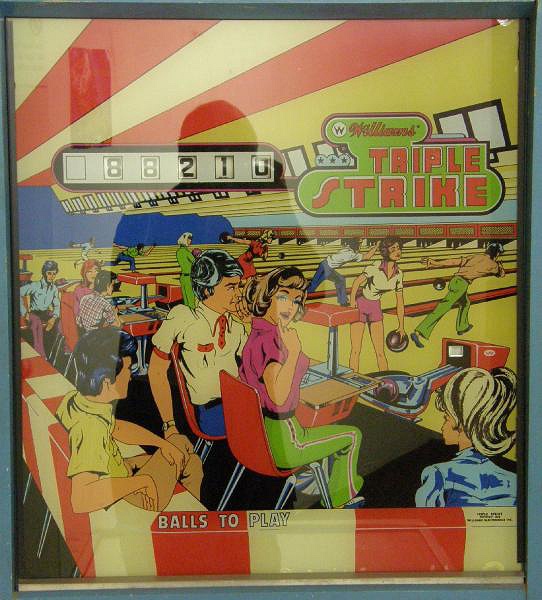
Triple Strike, released by Williams in 1975, remains a definitive example of the classic bowling-themed electromechanical era. Designed by industry titan Steve Kordek and featuring the unmistakable, stylized aesthetic of artist Christian Marche, this single-player machine distills the tension of the lanes into a fast-paced, high-stakes playfield. While it lacks the digital complexity of modern tables, its charm lies in its simplicity: a precise, symmetrical layout designed to reward accuracy and lane management, perfectly capturing the satisfaction of chasing that elusive perfect score.
The mechanical heart of Triple Strike revolves around its four drop targets, which serve as the primary objective for any player looking to rack up serious points. With thirteen strategically placed rollover buttons scattered across the playfield, the game demands constant vigilance and a deft touch on the flippers. A single pop bumper keeps the ball moving unpredictably, while the kick-out hole acts as both a potential hazard and a key scoring opportunity. For the competitive player, the primary strategy involves aggressive, repetitive targeting of the drop bank; clearing these targets is the only way to maximize the bonus scoring potential that defines the game’s high-score threshold.
Though it lacks the flashy gimmicks of later decades, Triple Strike stands as a testament to Kordek’s philosophy of accessible, addictive design. With over 3,300 units produced, it was a staple of the mid-70s arcade scene, challenging players to master its subtle geometry rather than just surviving its features. It remains a prized piece for collectors who appreciate the tactile, rhythmic clack of score reels and the pure, unadulterated focus required to conquer a classic EM sports title.