
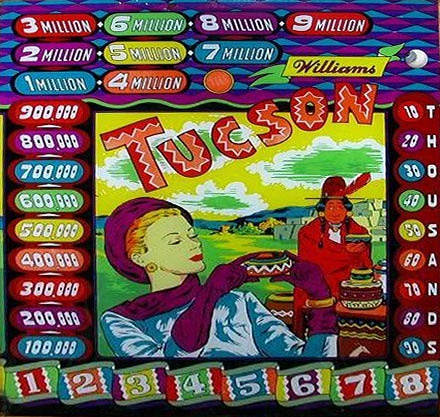
Tucson, released by Williams in the mid-20th century, stands as a minimalist relic of the electromechanical era. Designed by industry titan Harry Williams with art direction from George Molentin, this single-player machine strips pinball down to its purest, most rhythmic essence. Eschewing the complex multi-ball madness of modern cabinets, Tucson relies on a clean, classic layout that demands precise nudging and deliberate shot placement to conquer the playfield.
The board is anchored by a pair of flippers tasked with navigating the ball through a sparse yet challenging landscape. Featuring just two pop bumpers and a pair of kick-out holes, the game forces the player to master the geometry of the rebound rather than relying on heavy mechanical spectacle. It is a quintessential example of the “American Places” theme that was popular in the period, offering a nostalgic, grounded experience that emphasizes the tactile feedback of the era’s relay-based logic.
For those looking to master this vintage piece, success lies in controlling the flow toward the kick-out holes. Because the playfield is so open, the bumpers act as unpredictable agents of chaos; experienced players know to anticipate the ball’s erratic exits from the pop bumper zones to avoid draining down the center. Tucson is a masterclass in simplicity, proving that even a game with a modest feature set can provide a compelling, high-stakes session for any collector who appreciates the history of the craft.