
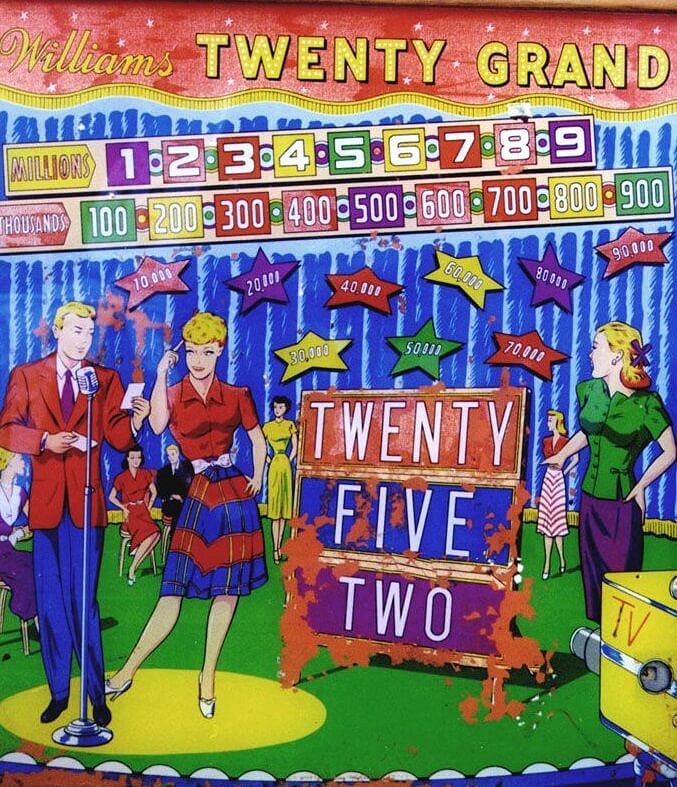
Twenty Grand, released by Williams in 1952, stands as a quintessential relic of the early electro-mechanical era, showcasing the sharp design sensibilities of industry legend Harry Williams. With artwork by George Molentin, the machine eschews the complex multiball mechanics of the modern era in favor of a high-stakes, precision-focused experience. The playfield is defined by an unusual density of scoring opportunities, featuring nine distinct trap holes that demand a surgical touch rather than raw, flipper-heavy aggression.
The mechanical layout is surprisingly sparse yet deceptively difficult, utilizing two active flippers alongside a collection of six passive bumpers and two traditional pop bumpers. This configuration turns the playfield into a strategic grid; the game’s core challenge lies in navigating the ball through the clutter to settle into those elusive trap holes. Because the machine lacks the high-speed ramp loops that define contemporary pinball, success on Twenty Grand is found in controlling the ball’s momentum and mastering the timing of the automatic flippers.
For the vintage enthusiast, this machine is a masterclass in minimalism. While it lacks the digital flair of modern tables, the sheer number of scoring pockets creates a tension that feels remarkably modern. Tournament players looking to conquer this classic should focus on identifying the highest-value trap holes early, as the game rewards consistent, methodical placement over chaotic play. It remains a fascinating look at a time when the “twenty grand” jackpot was the ultimate dream, captured perfectly through the simple, addictive geometry of mid-century engineering.