
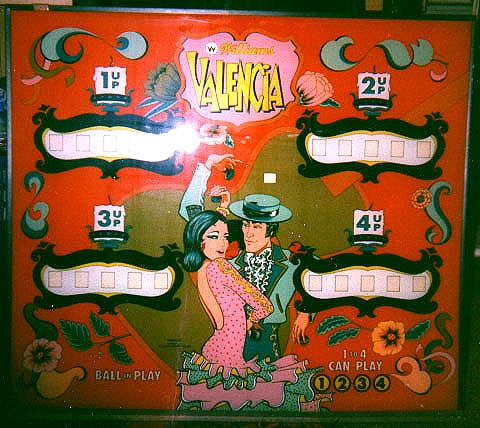
Valencia, a 1971 solid-state offering from Williams, stands as a classic representative of the era’s transition, bearing the unmistakable fingerprints of design legend Harry Williams. Featuring the vibrant, surrealist-leaning cabinet and playfield aesthetics of artist Christian Marche, the machine is a visual trip back to the early 70s. It eschews the digital flash of modern tables for the tactile satisfaction of reel-based scoring, challenging four players to navigate a playfield defined by a quartet of flippers and a strategic array of button targets and rollovers.
The mechanical layout is deceptively straightforward, centered around the interplay between its eight rollover buttons and eight button targets. With only two pop bumpers and a single kick-out hole to manage, the flow of the game relies heavily on accuracy and patience. The inclusion of four flippers allows for a more versatile, albeit challenging, style of play, forcing the operator to master the geometry of the table to hit the four standup targets efficiently. It is a quintessential “player’s game” that rewards rhythmic, deliberate shots rather than raw speed.
Because Valencia lacks the complex rule-stacking of modern machines, success here is found in mastering the geometry of the flipper layout. Focus your efforts on the rollover buttons to build your bonus multipliers; ignoring these in favor of simple target-bashing is a quick path to a low-scoring game. By keeping the ball in the upper quadrants of the playfield and utilizing the four flippers to cycle the ball back through the rollover lanes, you can maximize your scoring potential before the drain inevitably claims the ball. It is a masterclass in minimalist design that proves you don’t need a deep code stack to keep a crowd engaged.