
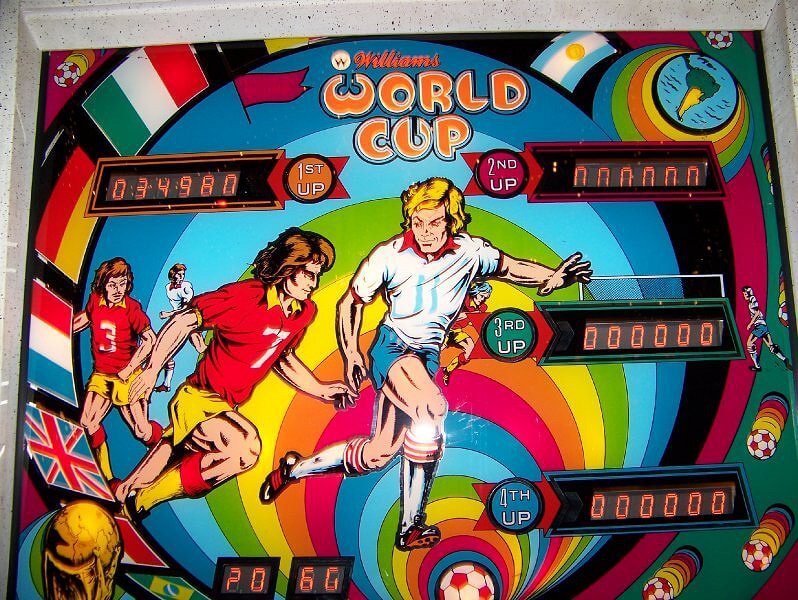
Williams’ 1978 classic, World Cup, stands as a quintessential example of the late-seventies solid-state era, capturing the fervor of international soccer through the lens of designer Edward Tomaszewski. With a production run exceeding 6,000 units, this sports-themed machine remains a staple for collectors who appreciate the elegant simplicity of early digital-era gameplay. The playfield is a lean, mean athletic field featuring two snappy flippers, a pair of active pop bumpers, and a central spinning target that mimics the chaotic momentum of a match on the pitch.
The objective is clear: navigate the playfield’s layout of rollover buttons and kick-out holes to dominate the scoreboard. Strategic mastery requires balancing the pursuit of spelling “STAR” with the clinical execution of scoring goals. Because your goal tally persists across your entire game, aggressive play early on is essential to building a massive score. When the goal light illuminates, the savvy player will cradle the ball before feeding it into the kicker, which expertly transfers the ball to the opposite saucer. If the opportunity isn’t lined up, shifting focus to the left orbit or right lane is the mark of a veteran player looking to keep the ball in motion.
Artistically, Christian Marche’s vibrant aesthetic perfectly complements the punchy, alphanumeric display and the straightforward, addictive mechanics. By successfully completing the “STAR” sequence, you don’t just inch closer to victory—you trigger bonus multipliers that elevate the value of every goal scored. World Cup is a masterclass in pacing, proving that you don’t need a complex array of modern toys to create a high-stakes, competitive atmosphere that feels just as intense as a championship final.