
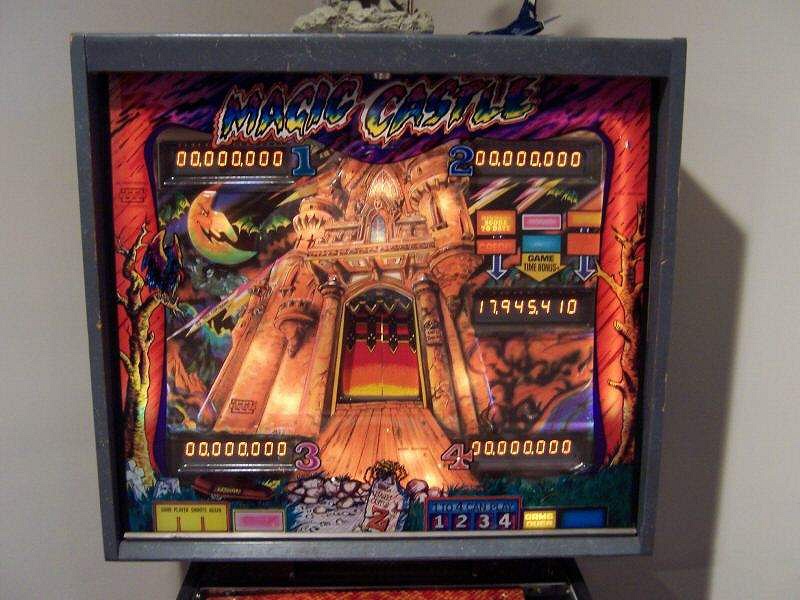
Magic Castle, released by Zaccaria in the mid-1980s, remains one of the most distinct entries in the Italian manufacturer’s catalog, leaning heavily into a macabre, gothic fantasy aesthetic. Featuring evocative artwork by Lorenzo Rimondini, the playfield is a dense challenge that utilizes four flippers to navigate a layout packed with drop targets—including a primary four-bank and a solitary target that demands precision. The machine’s most striking visual element is its mechanical backbox animation, a hallmark of Zaccaria’s commitment to physical spectacle that brings the vampire-themed narrative to life far above the playfield.
Gameplay on Magic Castle is an exercise in rhythmic target management. The fundamental loop encourages players to repeatedly hammer the A, B, and C standup targets to boost scoring potential, creating a mounting tension that rewards those who can transition smoothly into the ramp and drop target banks. The playfield geometry is unforgiving, particularly on the right side; however, savvy players can exploit a specific quirk of the machine, using a perfectly timed, single right-flipper twitch to nudge the ball away from a drain and back into play.
This is not a machine that relies on digital gimmicks, but rather on the tactile satisfaction of clearing banks and mastering the slightly unusual flow of its four-flipper configuration. It stands as a testament to Zaccaria’s unique design philosophy, prioritizing mechanical feedback and artistic cohesion. For those who appreciate the challenge of classic solid-state machines, Magic Castle offers a haunting, high-stakes experience that demands total focus from the first plunge to the final drain.