
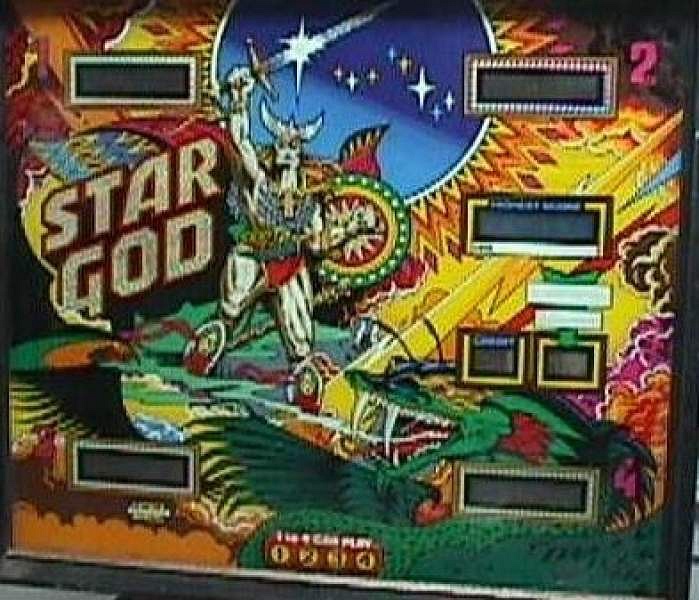
Star God, released by the Italian manufacturer Zaccaria, stands as a quintessential example of late-seventies/early-eighties solid-state design, dripping with the unique aesthetic flair that defined the era. Featuring striking cabinet and playfield art by Lorenzo Rimondini, the game leans into a surreal, high-concept fantasy theme that feels like a pulp sci-fi novel brought to life. Its mechanical layout is deceptively straightforward, centered around a pair of flippers and a playfield punctuated by rollunder spinners and a aggressive array of drop targets that demand precision rather than raw power.
The primary objective for any player looking to dominate the scoreboard is mastering the left-hand bank of four drop targets. This specific cluster is the engine of the game’s scoring economy; clearing the entire row in sequence incrementally builds your bonus multiplier, starting at 2x and climbing steadily to 5x. By prioritizing these targets, you can turn a modest round into a high-score run, provided you have the nerve to keep the ball away from the outlanes while working the bank.
Beyond the multipliers, the table utilizes an 8-bank memory drop target system that offers a satisfying sense of progression, rewarding players who can clear the playfield systematically. While it lacks the dense toy-heavy spectacle of modern machines, Star God excels in flow and classic challenge. It is a lean, focused experience that rewards disciplined aim, making it a favorite for those who appreciate the tactile, rhythmic nature of vintage Zaccaria engineering.