
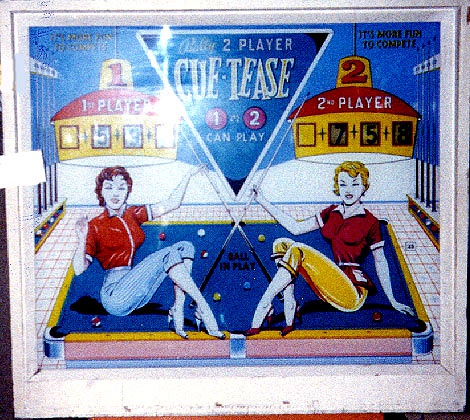
Cue-Tease, Bally’s 1968 foray into the world of billiards-themed electromechanicals, remains a rare bird in the hobby with only 500 units ever produced. Designed by the prolific Ted Zale, this two-player machine captures the tactile, high-stakes atmosphere of a pool hall through a minimalist lens. Eschewing the complex, multi-layered playfields of the modern era, Zale utilized a classic EM layout that relies on precision and rhythm, featuring a quartet of pop bumpers and a pair of passive bumpers that demand respect from any player hoping to keep the ball in play.
The mechanical charm of Cue-Tease lies in its deceptively simple geometry. The playfield is anchored by two flippers and a strategic rollover button tucked directly between them, a classic Zale touch that forces players to manage their cradle game with extreme care. With three standup targets and a pair of rollunders integrated into the layout, the game challenges you to navigate the playfield with the same finesse as a bank shot on a felt table. It is a quintessential example of late-sixties Bally engineering, where the satisfaction comes not from flashing LEDs or deep code, but from the satisfying “clack” of the score reels and the relentless, kinetic energy of a well-placed shot.