
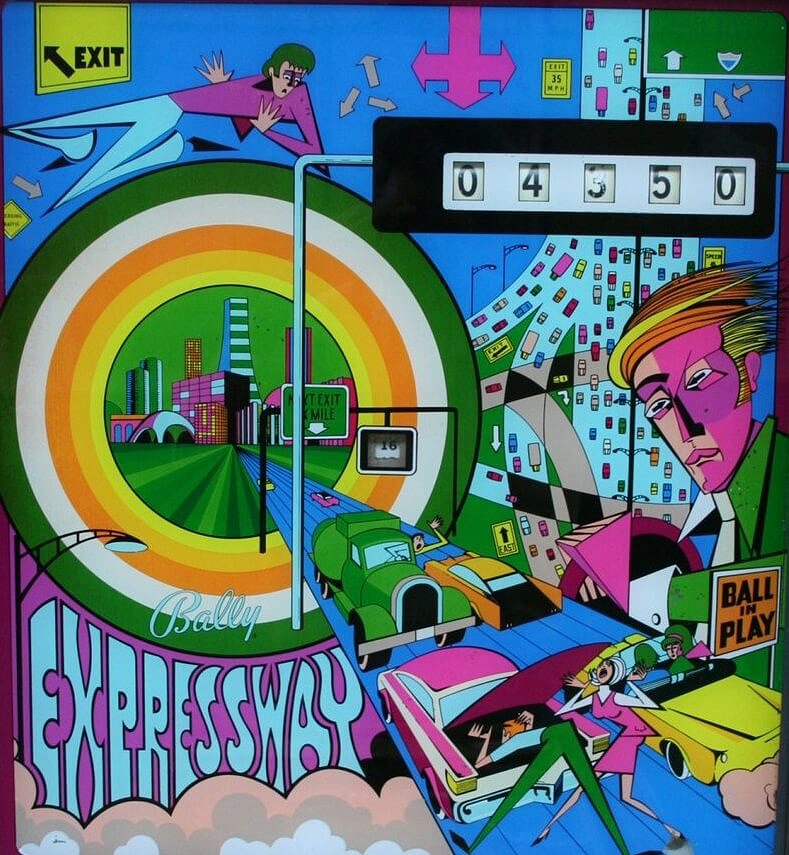
Expressway, released by Bally in 1963, stands as a quintessential example of Ted Zale’s design philosophy during the golden age of electromechanical machines. Featuring vibrant, kinetic artwork by Christian Marche, the playfield is a frantic, high-speed travelogue that abandons the standard layout for a unique configuration centered around six mushroom bumpers. These specialized bumpers, paired with three traditional pop bumpers, create a chaotic, unpredictable flight path for the ball that demands quick reflexes and a mastery of the machine’s geometry.
The mechanical heart of Expressway lies in its defensive and recovery features, specifically the left-side kickback lane and the center up-post situated between the flippers. These elements were designed to keep the ball in play longer, rewarding players who can navigate the congestion of the kick-out holes and rollover buttons scattered across the board. Because the machine relies on classic reel-based scoring, every successful shot into the kick-out holes feels like a hard-won victory against the unforgiving nature of the playfield’s layout.
For those looking to conquer this mid-century classic, the key is mastering the rhythm of the mushroom bumpers. Rather than trying to control the ball with precision, successful players learn to use the bumpers’ irregular rebound angles to their advantage, feeding the ball back into the scoring lanes rather than letting it drain. With only 1,555 units produced, Expressway remains a rare, high-octane relic that captures the restless energy of early 60s pinball design—a must-play for anyone who appreciates the raw, analog challenge of a Zale-era Bally.