
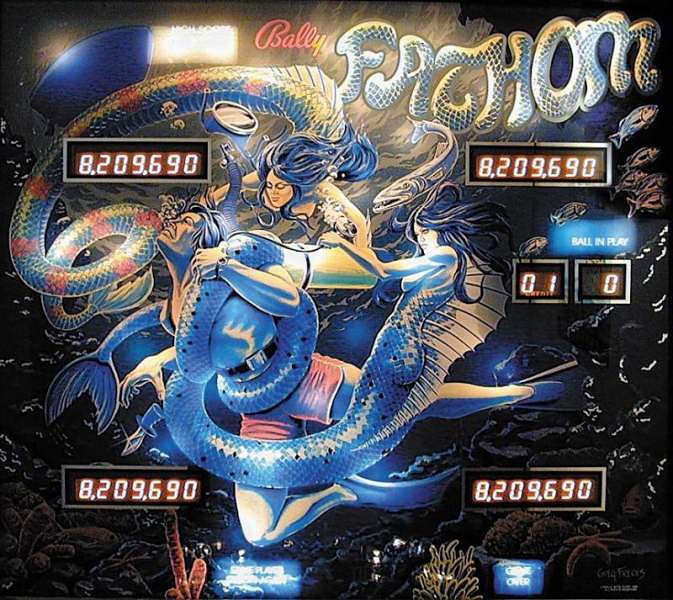
Bally’s Fathom, released in 1981 and designed by Ward Pemberton, is one of the most beautiful machines of the early solid-state era — a dreamy underwater fantasy of mermaids and sea monsters, rendered in gorgeous blues and purples by artists Greg Freres and Kevin O’Connor. Beneath that stunning artwork sits a deep, rewarding three-ball multiball game built around a clever color-coded drop-target system, with around 3,500 made.
The heart of the game is the locks and the colors. A ball shot into the saucer stays locked and resets the three in-line drop targets in front of it — knock all three down to release the ball. The drops come in colors, and completing three same-colored drops on the left rewards an in-line drop of the same color, building toward the multiball. During multiball, you can re-lock balls and free them by completing the correct-colored drop banks, a satisfying puzzle of timing and aim. Watch out, though — locks can be stolen by opponents in multiplayer.
There’s genuine depth for the dedicated, from advancing the blue and green bonus multipliers (up to 5X, carried into extra balls) to the cascade of specials earned by reaching 55K bonuses and completing the ABC lanes. Beautiful, deep, and beloved, Fathom is widely regarded as one of the finest games of its era and the high point of Ward Pemberton’s career. The color-matching multiball is deceptively deep, rewarding a player who plans which drops to clear in which order, and the cascade of specials at the high bonus thresholds gives the dedicated plenty to chase. Between its serene beauty and that clever ruleset, Fathom is a machine that rewards a second, third, and hundredth look — a serene, stunning table that plays as wonderfully as it looks. Dive in.