
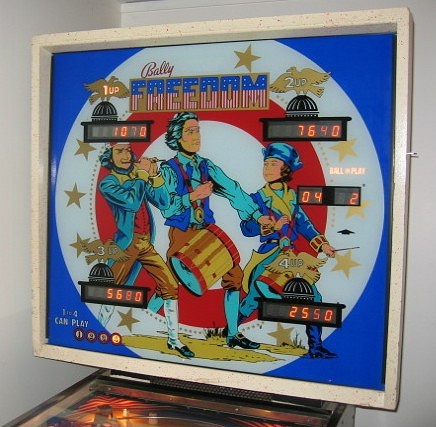
Freedom, released by Bally in 1976, stands as a quintessential artifact of the Bicentennial era, capturing the patriotic fervor of the United States’ 200th anniversary through the distinct, stylized lens of artist Christian Marche. As an early solid-state entry in Bally’s catalog, it serves as a bridge between the mechanical clatter of the past and the precision of the digital age. The playfield layout is deceptively straightforward, dominated by a formidable five-bank of drop targets that demand accuracy, flanked by a pair of spinning targets that reward the player for keeping the ball in high-velocity motion.
The gameplay experience revolves around the pursuit of escalating multipliers and the strategic use of the machine’s two kick-out holes. Scoring success on Freedom is heavily tied to the spinner values, which climb from a modest 10 to a lucrative 1,000 points, making them a crucial target for players looking to rack up a competitive score. Mastery of the table often comes down to navigating the orbit shots, which feed the top saucer to grant the highly coveted double bonus. With two saucers and outlanes capable of collecting the “wheel” awards, the game presents a fascinating risk-reward dynamic where a controlled drain can occasionally be more beneficial than a desperate save.
While its production run was limited to 1,500 units, Freedom remains a cherished title for collectors who appreciate the transitional period of pinball history. It is a game that rewards patience and deliberate target selection, favoring those who can keep the ball circulating through the spinners and saucer loops. By balancing the pursuit of major bonus multipliers against the tactical collection of wheel awards, players can unlock the full potential of this vintage Bally classic, proving that even a simple layout can offer deep, enduring strategy.