
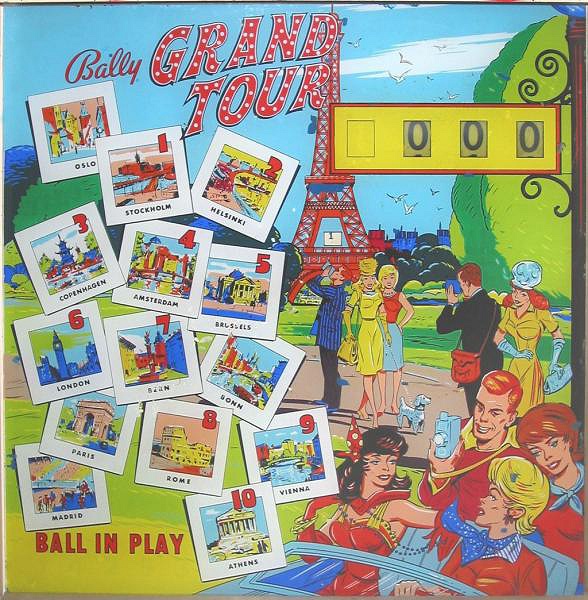
Bally’s 1964 *Grand Tour* stands as a quintessential artifact of the mid-century electromechanical era, crafted by the legendary designer Ted Zale. Eschewing the complex narratives of modern machines, this single-player title captures the romantic, jet-setting spirit of international travel that defined the early sixties. Built with a production run of just over 1,300 units, the playfield is a vibrant, map-inspired landscape that trades digital depth for the tactile, satisfying clatter of classic reel scoring and high-tension gameplay.
The mechanical layout is deceptively simple, relying on a classic two-flipper configuration to navigate a crowded field of targets. Zale packs the playfield with a mix of three traditional pop bumpers and four unique mushroom bumpers, which demand precise ball control to activate. The inclusion of butterfly rollovers adds a layer of aesthetic charm, while the right outlane ball return gate serves as a crucial mechanical mercy, offering a rare second chance for players who might otherwise lose their ball to the drain. It is a game of rhythm and momentum, where the goal is to master the bounce and keep the ball dancing across the mushroom bumpers to rack up a high score.
For those stepping up to the machine, the strategy is rooted in the purity of early Bally design. Since the machine rewards consistent, clean shots to the bumper clusters, focus your flipper work on keeping the ball in the upper third of the playfield. The return gate on the right is your best friend—learn to nudge the cabinet effectively when the ball tracks toward that outlane, as triggering the gate is the difference between a high-scoring run and an abrupt finish. *Grand Tour* remains a testament to an era when pinball was about the tactile thrill of the steel ball against wood and wire, offering a travelogue experience that feels just as adventurous today as it did decades ago.