
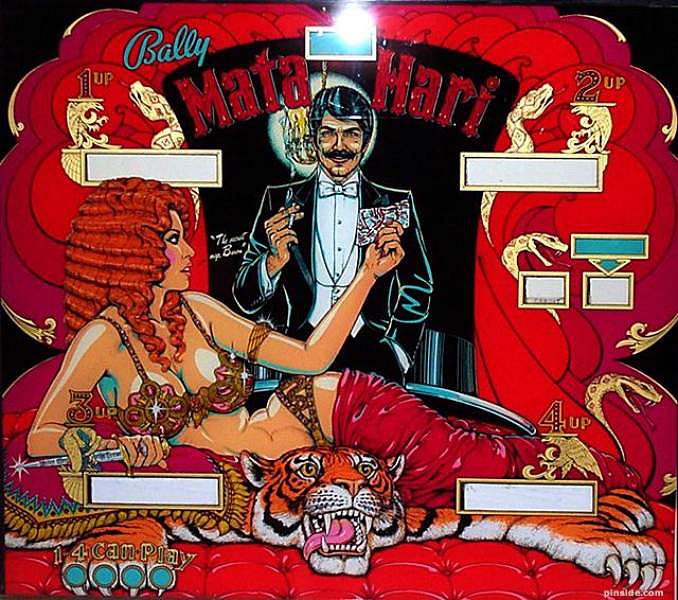
Named for the legendary World War I dancer-turned-spy, Bally’s Mata Hari brought a dose of cloak-and-dagger glamour to the flippers in 1977. It arrived right at the industry’s tipping point, produced in both electromechanical and solid-state forms as arcades cautiously embraced the new computerized hardware. Designed by Jim Patla with artwork by Dave Christensen, it’s a clean, fast-playing two-flipper layout anchored by twin four-bank drop targets and a tempting top saucer.
The strategy is delightfully old-school and saucer-centric. That kick-out hole up top is the engine of the game — it advances your bonus multiplier and lights the 50,000-point outlane awards, so players who can reliably feed it will see their scores climb in a hurry. The trick, as veterans know, is touch: the saucer often needs a gently lobbed shot to settle in cleanly rather than a hard rip. Completing a full bank of drops drops an instant 50,000 in your lap, a satisfying reward for accuracy.
As an artifact of pinball’s late-1970s transition, Mata Hari is a charming and accessible classic — simple enough to grasp in one ball, but with just enough risk-reward tension around that saucer to keep a competitive player honest. For collectors drawn to the early solid-state era and its elegant, uncluttered playfields, it’s a handsome and historically interesting table that still plays a sharp game of espionage.