
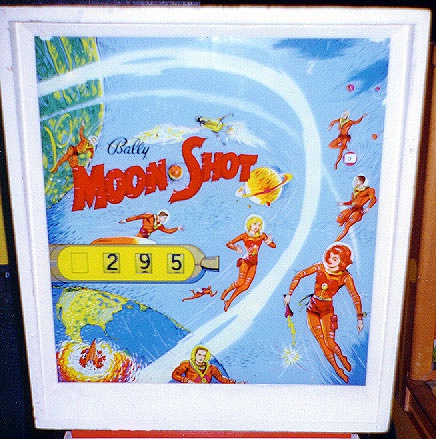
Moon Shot, released by Bally in 1963, remains a distinct artifact of the early space-race era. Designed by the legendary Ted Zale, this electromechanical single-player machine captures the mid-century obsession with lunar exploration through a stripped-back, high-tension playfield. With a production run of only 1,250 units, it stands as a quintessential example of Zale’s ability to maximize the potential of simple layouts, relying on precise ball movement rather than the complex multi-toy systems that would dominate later decades of pinball history.
The mechanical architecture of Moon Shot is defined by its quartet of pop bumpers and a trio of rollunders, which force the player to master nudging and timing to navigate the space-themed terrain. Four standup targets act as the primary objectives, demanding accuracy to rack up points on the classic reel displays. Unlike the modern “everything-and-the-kitchen-sink” approach to playfield design, Zale’s work here is surgical; the two flippers are positioned to make every shot feel consequential, rewarding players who can anticipate the rebound off the pop bumpers to keep the ball in play.
For collectors and vintage enthusiasts, Moon Shot is a masterclass in minimalist design. The challenge lies in the geometry—there are no magnets or motorized ramps to save a poor trajectory, only the player’s ability to manage the rollover buttons and lane flow. It is a machine that demands patience and a rhythmic touch, serving as a nostalgic reminder of a time when the “Moon Shot” was a national aspiration and the pinball experience was measured in the satisfying click of mechanical score reels.