
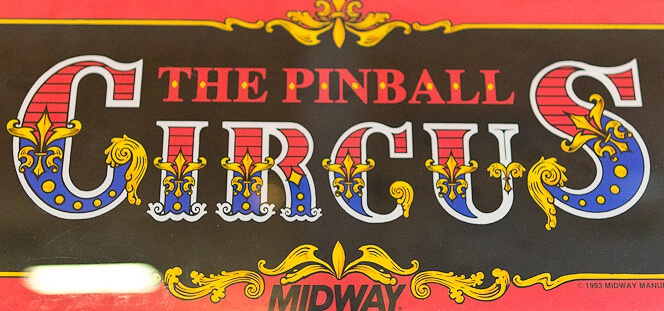
Pinball Circus, the legendary 1994 Bally prototype designed by the visionary Python Anghelo, remains one of the most mythical artifacts in the hobby. With only two units confirmed to exist, this machine is the ultimate “white whale” for collectors. Eschewing the standard flat-playfield paradigm, Anghelo crafted a vertical, multi-tiered carnival spectacle that looks more like a high-end midway attraction than a traditional pinball table. It is a dizzying, ambitious feat of engineering that forces players to navigate a sprawling, upward-climbing layout, challenging the very definition of how a ball should travel through a machine.
The gameplay experience is defined by its sheer scale, utilizing an unprecedented seven flippers to push the ball through various carnival-themed levels. The playfield is a dense cluster of mechanical activity, featuring four pop bumpers, a strategic bank of three drop targets, and a precise kick-out hole that serves as a gateway between the machine’s distinct vertical zones. Because the playfield is layered, the flow is frantic and unconventional; the ball doesn’t just move side-to-side, but constantly fights gravity to ascend the circus structure.
While the hardware is a masterclass in eccentric design, the presentation is equally iconic, featuring the singular artistic touch of Pat McMahon paired with the unmistakable audio-visual polish of Dan Forden. Everything from the dot-matrix animations to the sound package is tailored to immerse the player in a surrealist, high-stakes carnival. For the few who have had the privilege of stepping up to a Pinball Circus, the machine represents a daring “what if” moment in Bally’s history—a glorious, complex, and utterly singular experiment that pushed the mechanical limits of the silver ball to their absolute breaking point.