
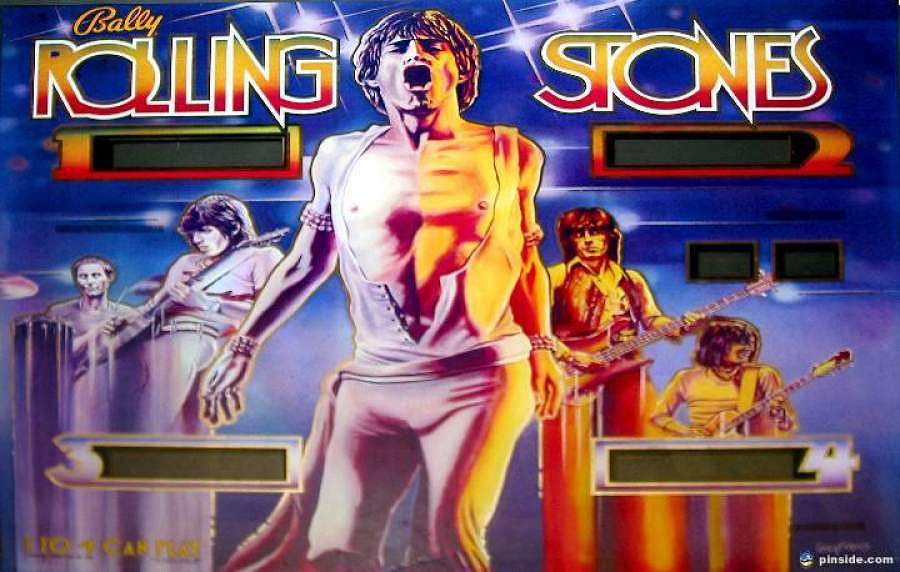
You can’t always get what you want, but you can get a great game out of Bally’s 1979 Rolling Stones — a celebrity-licensed slice of late-’70s rock and roll designed by Jim Patla with art by the great Greg Freres. With a healthy confirmed run of 5,700, this four-player put the world’s most famous rock band on the backglass and gave route players a clean, punchy solid-state layout: two flippers, three pops, a four-bank of drops, twin horseshoe lanes, and a kick-out hole, all humming with attitude.
The strategy, like the best Stones riffs, is built on a simple repeatable hook. The left orbit behind the drop target is the shot you play all day, a low-risk groove that keeps the points coming. The bonus system has a fun wrinkle worth knowing: rather than the usual build, lighting the 20-40-60 values comes from completing the 1-2-3-4-5 spot targets, a different rhythm from the standard bonus climb. And when the center target is lit and flashing, hitting it spots a letter in R-O-C-K — the easy, reliable way to pump your bonus multiplier and turn a steady game into a high score.
Rolling Stones is a terrific example of how the late-’70s licensed machines paired star power with tight, accessible design. It doesn’t ask much of you beyond learning that left orbit and watching for the flashing center target, but a player who works those two ideas patiently will climb the scoreboard. It’s loud, it’s catchy, and it captures the swagger of its namesakes without needing a single ramp or dot display. Groove the left orbit, spell ROCK, and let it bleed. Start me up.