
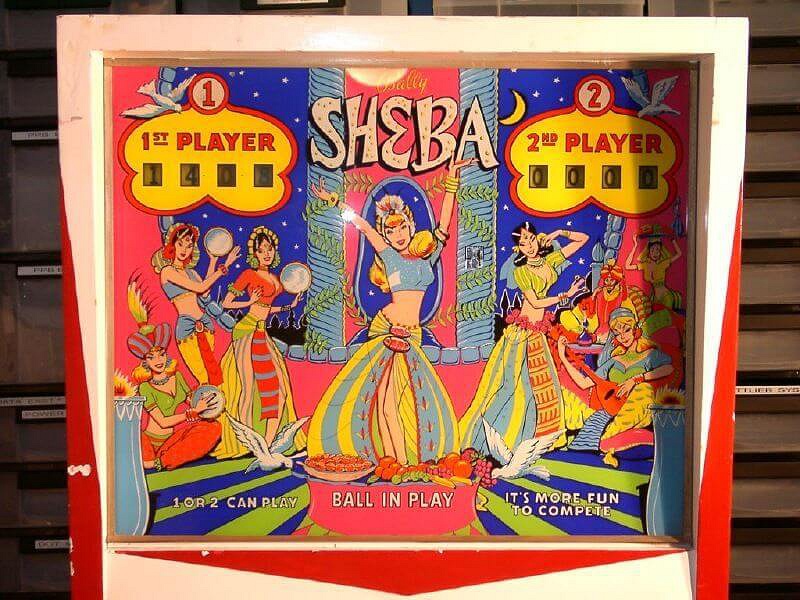
Sheba is a rare slice of mid-century electromechanical history from Bally, emerging in 1968 under the watchful eye of designer Ted Zale. With only 825 units ever produced, this two-player machine is a quintessential example of Zale’s penchant for unconventional playfield geometry and mechanical ingenuity. The game leans into its mid-century adventure theme with a playfield dominated by three pop bumpers and a unique set of five mushroom bumpers, which act as the primary engines for both scoring and board manipulation.
The gameplay on Sheba revolves around a clever gate-based economy that rewards precision target shooting. Players must systematically clear targets one through five to swing open the bottom gate for a 500-point reward, while the sixth target manages the top gate for an equal bonus. The mushroom bumpers add a layer of tactical risk; the blue number two bumper acts as a “zip” mechanism that tightens the flipper gap, while the red number one and three bumpers serve to “unzip” or widen the play area. Navigating these transitions is the key to mastering the table’s flow and keeping the ball in play.
While Sheba lacks the complex rule sets of modern machines, its charm lies in its simplicity and the tactile satisfaction of its reel-based scoring. The inclusion of three ball return gates ensures that the ball is constantly being recycled back into the action, keeping the pace brisk for an EM of its era. It remains a fascinating relic of Bally’s golden age, demanding a steady hand and a keen eye for target management to keep the score reels spinning.