
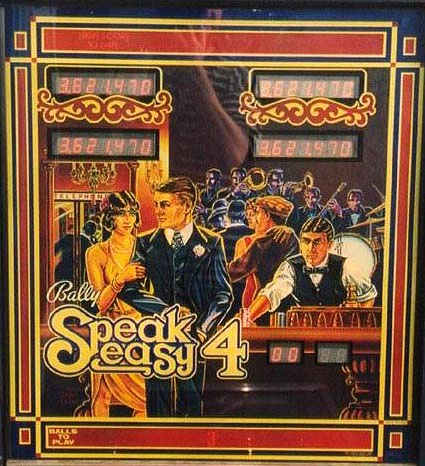
Bally’s 1982 release, *Speakeasy*, stands as a unique, Prohibition-era relic that captures the illicit charm of a 1920s underground club. Designed by George Christian with striking, era-appropriate cabinet art by Greg Freres, the machine leans into its American history theme with a layout that feels distinctly classic. While it utilizes a standard two-flipper configuration, the playfield is defined by its mechanical centerpiece: a functional roulette wheel integrated directly into the surface. This toy transforms the game from a standard solid-state experience into a high-stakes gamble, forcing players to balance traditional shot accuracy with the unpredictable nature of a spinning wager.
The gameplay is anchored by a five-bank of “flyaway” targets that demand precision, flanked by a trio of pop bumpers that keep the action frantic. Unlike many of its contemporaries that focused on long-form wizard modes, *Speakeasy* emphasizes the “Add-A-Ball” mechanic, turning the pursuit of extra balls into the primary objective for those looking to extend their time at the table. With two kick-out holes providing secondary scoring opportunities and the roulette wheel constantly looming, the game rewards players who can maintain composure amid the chaotic, high-energy environment of a bustling gin joint.
With a production run of 3,000 units, *Speakeasy* remains a sought-after title for collectors who appreciate Bally’s experimental era. It is a quintessential example of how designers in the early 80s integrated physical games of chance into the pinball experience. Mastery of this table requires an understanding of the roulette wheel’s rhythm; rather than relying solely on repetitive ramp loops, successful players must treat the playfield as a shifting landscape where the risk of the spin is just as vital as the accuracy of the flipper shot.