
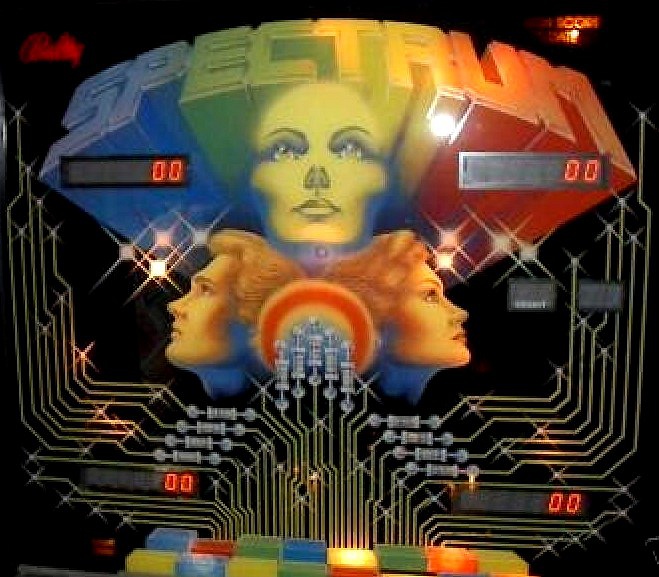
Spectrum, released by Bally in 1982, remains one of the most intellectually demanding tables of the early solid-state era. Designed by Claude Fernandez, the machine trades traditional ramp-heavy layouts for a logic-based puzzle aesthetic that feels more like a high-stakes game of Mastermind than a standard arcade experience. With its stark, fantasy-inspired art by Margaret Hudson and a playfield dominated by four banks of three-bank drop targets, the game challenges players to decode a hidden sequence of colors. It is a rare, low-production gem—with fewer than a thousand units ever leaving the factory—that rewards patience and pattern recognition over mindless ball-bashing.
The mechanical gameplay revolves around the grid, where you must deduce the correct color sequence by chipping away at the drop target banks. The center kick-out hole is your tactical anchor; if you can master the shot, it acts as a diagnostic tool, providing clues to guide your next move. The game provides visual feedback through a grid system where flashing lights indicate a correct guess, solid lights signal a blunder, and swirling lights signify your active selection. Strategy dictates that you avoid repeating colors within the same row, as every drop target hit contributes to your bonus multiplier, ensuring that even your “incorrect” guesses help build a massive score before you finally crack the code.
For those hunting a high score, the key is to prioritize filling columns early to establish a baseline of information. Clearing the entire grid is the ultimate goal, unlocking substantial point values that, when combined with a healthy multiplier, can vault your score into the six-figure range. The inclusion of five kick-out holes—including a clever dual-action mechanism—keeps the ball moving with a frantic, unpredictable cadence. Spectrum is a distinct, cerebral relic that forces you to think as quickly as you flip, standing as a testament to an era where Bally wasn’t afraid to experiment with the very definition of a pinball objective.