
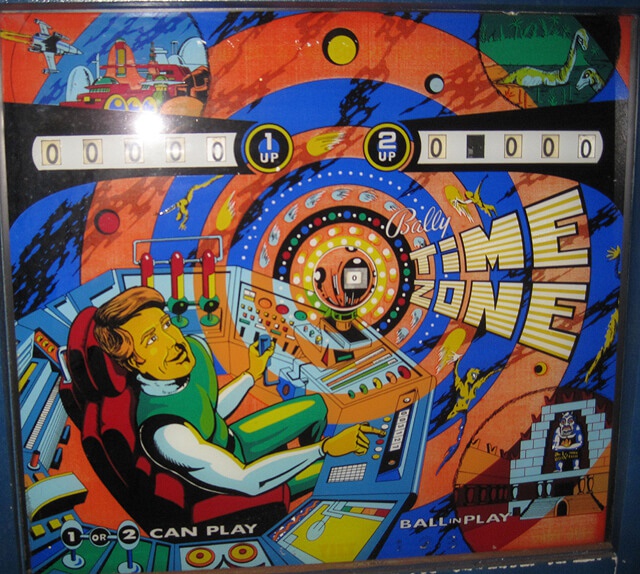
Time Zone, a 1972 release from Bally, stands as a quintessential artifact of the electromechanical era, blending Jim Patla’s precise design with the distinct, stylized visuals of artist Christian Marche. Eschewing the complex multi-ball modes of modern machines, this science-fiction-themed table leans into the frantic, tactile satisfaction of 1970s pinball. The playfield is defined by its clever use of gates and a lower-playfield “tunnel” feature that utilizes flashing lights to create a sense of depth and urgency, challenging players to navigate a gauntlet of four pop bumpers and dual kick-out holes in their quest to conquer the space-time continuum.
The game’s core loop relies on precision timing and a rhythmic mastery of the center-post mechanic. A seasoned player knows that the key to high scores lies in the tunnel; by carefully timing the plunge, you can trap a high-value score before hitting the center target to secure the points and trigger the center up-post. This post becomes your best friend in a game prone to a greedy center drain, acting as a crucial safety net. Because the playfield geometry favors wide, sweeping shots, the most effective strategy involves toggling between the right-side tunnel reset and the left-side collect, the latter of which offers the tantalizing prospect of an extra ball.
With only 2,500 units produced, Time Zone is a rare, mid-century gem that rewards patience and a gentle touch. It is a deceptively simple machine that demands a rhythmic flow, forcing the player to balance the risk of aggressive nudging against the volatility of the center drain. For those who appreciate the raw, mechanical honesty of reel-based scoring and the aesthetic charm of the early 70s, Patla’s time-traveling creation remains a compelling test of fundamental flipper skills.