
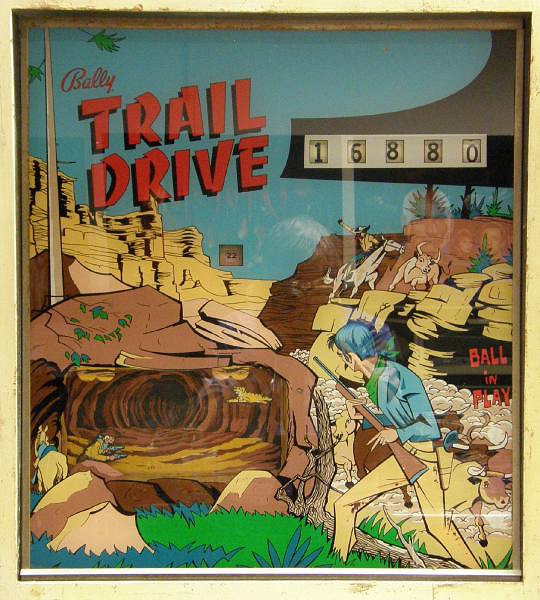
Trail Drive, released by Bally in 1968, stands as a quintessential piece of the Ted Zale era, capturing the rugged spirit of the American West with the charm of classic electromechanical design. Featuring the distinct, high-energy artwork of Christian Marche, the cabinet and playfield pop with a frantic, stylized energy that perfectly complements the “cowboy” theme. Zale, a master of utilizing every square inch of the playfield, packed this single-player machine with a dense array of bumpers and targets that demand precision in an era defined by fast, chaotic action.
The machine’s true showstopper is its mechanical backbox animation, a hallmark of Bally’s creative engineering during the late sixties. While the player battles to navigate the ball through a gauntlet of three pop bumpers and four mushroom bumpers—the latter providing that satisfying, distinct “thud” and aggressive rebound—the backglass comes to life, tracking the progression of the cattle drive. Strategic play centers on the two kick-out holes and the lone standup target; managing these shots is essential to advancing the game’s progress, while the right outlane ball return gate offers a rare, merciful lifeline for those errant shots that would otherwise end a run prematurely.
With only 1,305 units produced, Trail Drive is a prized find for collectors of vintage Bally machines. It represents a period where gameplay was stripped to its rawest form: no deep rule sets or complex LCD menus, just the rhythmic clatter of score reels and the tactile satisfaction of a well-timed flipper shot. It remains a fantastic example of how Zale used mechanical ingenuity to transform a standard Western trope into a high-stakes, fast-paced test of reflexes that still holds up on any modern arcade floor.