
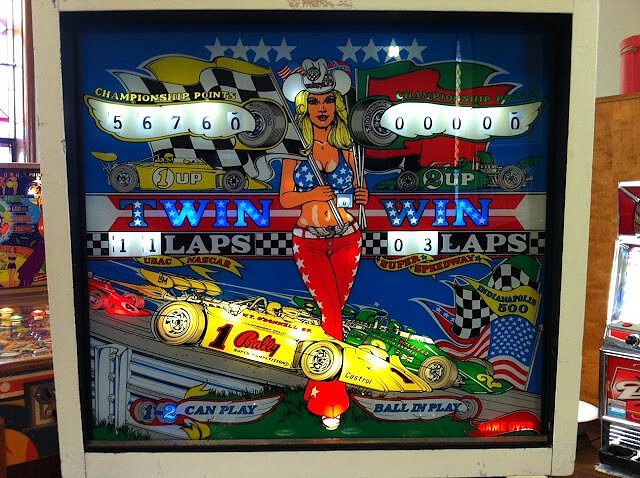
Twin Win, released by Bally in 1977, is a quintessential slice of late-seventies electromechanical adrenaline. Designed by Jim Patla with the high-octane visual flair of artist Dave Christensen, this auto-racing-themed machine captures the raw energy of the track without the need for digital screens or complex rulesets. With only 1,570 units produced, it remains a rare, focused experience that relies on the tactile satisfaction of its four flippers and a playfield packed with mechanical obstacles rather than software-driven modes.
The layout is a masterclass in classic EM density, forcing players to navigate a gauntlet of fourteen standup targets and four distinct mushroom bumpers that demand precision rather than brute force. The playfield is further complicated by a central spinning disc—a signature feature of the era that introduces a layer of chaotic physics, occasionally sending the ball careening in unpredictable directions. With two kick-out holes providing high-scoring opportunities and two pop bumpers adding to the frantic pace, the game rewards those who can maintain control amidst the mechanical disorder.
For players looking to master the circuit, the strategy revolves around managing the board’s congestion to keep the ball in play while hunting for the high-value standup targets. Because the machine features dual kick-out holes, timing your shots to land in these pockets is essential for padding your score, but the real challenge lies in anticipating the erratic trajectories off the spinning disc. Twin Win is a stripped-down, aggressive tribute to the golden age of racing, proving that when the engineering is this tight, you don’t need a deep rulebook to feel the heat of the race.