
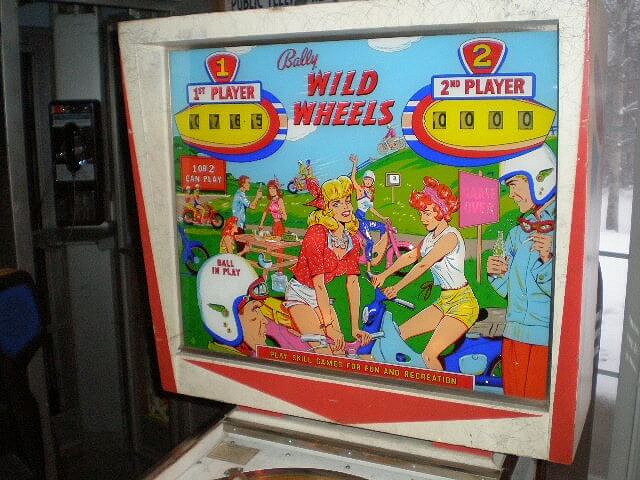
Wild Wheels, released by Bally in 1970, stands as a quintessential piece of EM-era nostalgia from the desk of design legend Ted Zale. With art by George Molentin, the machine leans into a breezy, mid-century aesthetic centered on the freedom of two-wheeled travel. While its production run was limited to just 580 units, the table remains a fascinating study in the minimalist, high-action gameplay that defined the early seventies, relying on a classic two-flipper layout and a sprawling network of seven mushroom bumpers that turn the playfield into a chaotic pinball pinball arena.
The mechanical heart of Wild Wheels is its dense cluster of mushroom bumpers, which demand sharp reflexes and precise nudge management. Unlike the standard pop bumpers found on contemporary tables, these mushroom variants offer a unique, tactile response that punishes poor aim while rewarding players who can keep the ball circulating through the center of the playfield. The experience is rounded out by a right outlane free ball gate, a crucial “safety valve” that provides a much-needed second chance for players caught in the high-speed crossfire of the game’s aggressive geometry.
For those tracking down this Bally rarity, the strategy is straightforward but punishing: prioritize control over raw power. Given the density of the mushroom bumper array, trying to force shots often leads to a quick drain; instead, focus on catching the ball on the flippers to settle the play before navigating the gaps. Despite its age and simplicity, Wild Wheels captures the kinetic energy of its motorcycle theme, offering a vintage, two-player challenge that rewards the steady hand of a true mechanical purist.