
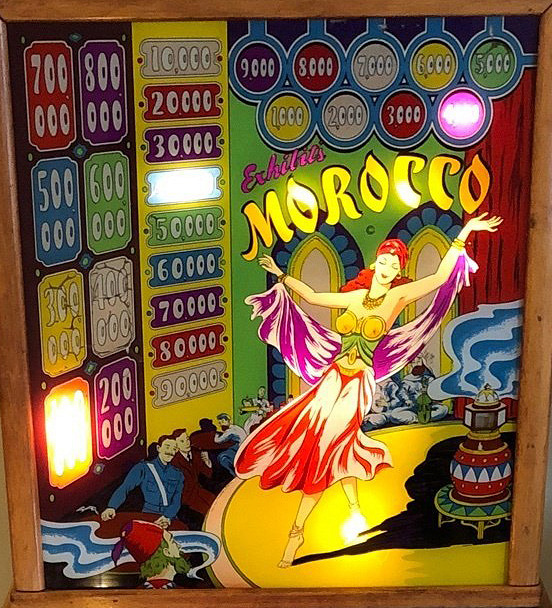
Morocco, a vintage Electromechanical title from the Exhibit Supply Company, stands as a curious relic of mid-century arcade design. Eschewing the complex multi-level playfields of the modern era, this machine focuses on the raw, tactile challenge of ball control in an era when pinball was as much about physical mastery as it was about scoring. Its theme transports players to a stylized vision of a North African marketplace, a common aesthetic choice for games of that period intended to evoke the exoticism and wanderlust of the mid-20th century.
The mechanical heart of Morocco lies in its unconventional layout, most notably its use of reverse-action flippers. Unlike the standard upward-facing flippers found on almost every other machine, these demand a complete recalibration of a player’s muscle memory, turning every shot into a deliberate exercise in precision. The playfield is densely populated with a mix of five spring-compression bumpers and four passive bumpers, which act more like erratic, bouncing sentinels than the active scoring targets seen in later years. Navigating the ball through these clusters requires a deft touch, as the rollover buttons are placed in high-traffic zones that punish heavy-handed play.
Because this is a single-player, light-based EM machine, there are no digital displays or complex rulesets to track; the focus is entirely on the geometry of the table. For the modern enthusiast, the strategy is less about chasing modes and more about mastering the rhythm of the bounce. With its lack of modern safety nets and its counter-intuitive flipper orientation, Morocco serves as a challenging reminder of a time when the game was defined by its mechanical quirks and the sheer difficulty of keeping the ball in play.