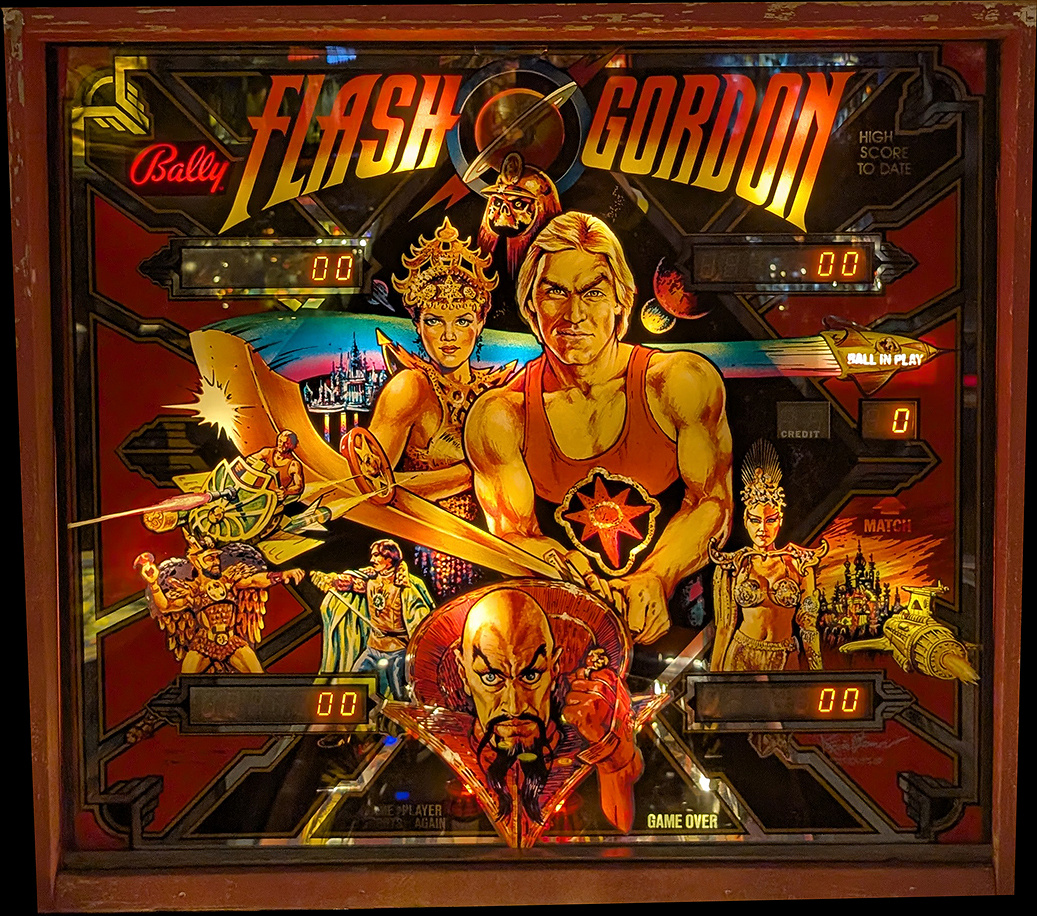
Tied to the gloriously over-the-top 1980 sci-fi film, Bally’s Flash Gordon rocketed to become the manufacturer’s best-selling game of 1980, with around ten thousand tables flying out the door. Designed by Claude Fernandez with iconic artwork by Kevin O’Connor, it broke new ground for Bally as the company’s first split-level playfield and one of its earliest talking machines, debuting the “Squawk and Talk” sound board that gave it those memorable, larger-than-life voices.
The split-level layout keeps the action varied and the bonus-multiplier hunt central. Multipliers are scattered cleverly across the table — 2X and 3X at the lower-right drops, 4X up top, and a big 5X at the lower-left bank — so a methodical player learns the order to chase them. Completing the lower-left drops lights a spinner; do it twice and both spinners come alive, fueling the kind of point-stacking that makes the game sing. There’s real shot-making finesse on offer too, from backhanding the right ramp off the right flipper to even backhanding the bonus collect in the shooter lane on some machines.
Famous among die-hards for its challenging speed, its strobe-lit backbox, and O’Connor’s intricate, comic-book artwork, Flash Gordon endures as a high point of early-1980s Bally design. It’s a loud, fast, beautiful machine that captures all the pulpy heroics of its source — the kind of table that still draws a crowd whenever its voices start booming across the arcade.