
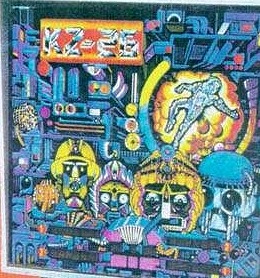
KZ-26, released by the Spanish manufacturer Playmatic, stands as a distinct relic of the solid-state era, capturing the mid-period fascination with cold, futuristic outer space aesthetics. While Playmatic machines often fly under the radar compared to their American contemporaries, the KZ-26 leans heavily into the stark, sci-fi themes that defined late-70s and early-80s arcade design. It utilizes an alphanumeric display to track the scores of up to four players, grounding its fantasy-driven playfield in the reliable, rhythmic architecture common to the European market during that transitional period of pinball evolution.
The game is a masterclass in minimalist space-fantasy, focusing on precision and the tactile satisfaction of the era’s mechanical components. Without the crutch of modern multi-ball complexity or deep, rule-heavy code, the KZ-26 demands a disciplined approach to the playfield. Success on this machine relies on mastering the flow between the standard flipper geometry and the target banks, which are strategically positioned to reward players who can maintain ball control rather than those who simply rely on brute-force shots.
For the modern collector, the KZ-26 is a fascinating study in international engineering. Its design philosophy emphasizes steady, repetitive scoring through target completion, making it a challenging test of consistency for anyone looking to step away from the cinematic, high-intensity play of modern licensed pins. It remains a stark, atmospheric tribute to the “Space Race” era of pinball, offering a refreshingly straightforward experience that forces the player to engage with the machine’s geometry rather than its software.