
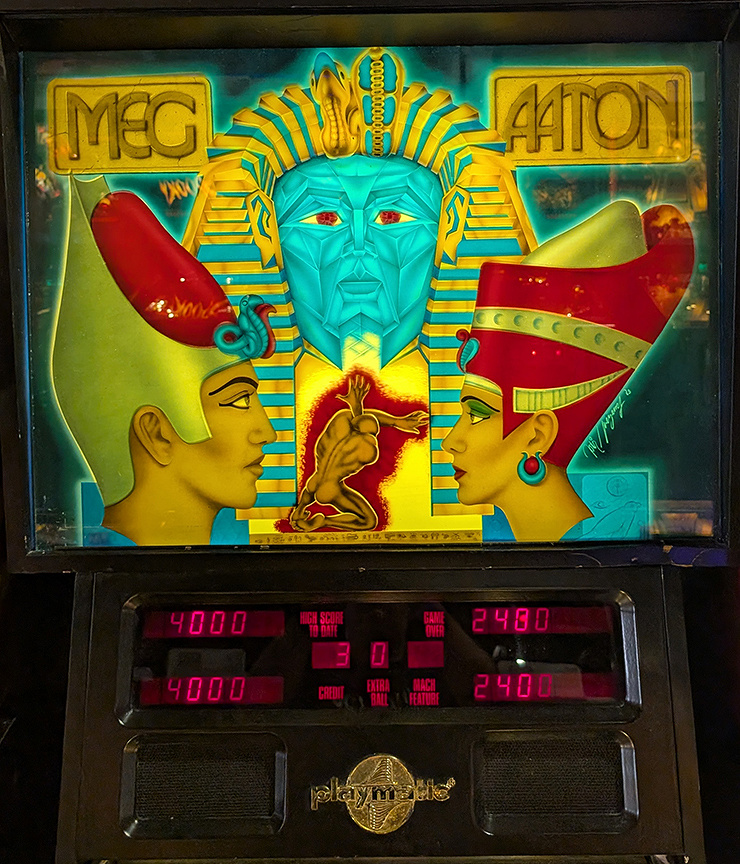
Megaaton by Playmatic is a striking artifact of the mid-1980s solid-state era, representing the Spanish manufacturer’s bold attempt to capture the high-tech, aggressive aesthetic of the decade. The machine’s most immediate and commanding feature is its cabinet design; Playmatic eschewed traditional rectangular geometry in favor of a distinctively sculpted backbox. This angular, futuristic silhouette heavily borrows from the cabinet design pioneered by Bally’s 1982 rapid-fire arcade-pinball hybrid, giving the game an imposing, militaristic profile that stood out on crowded European arcade floors.
Behind the glass, this four-player game utilizes crisp alphanumeric displays to elevate its competitive tension, allowing players to easily track their standing during multi-player showdowns. Playmatic’s design philosophy during this period favored tight, high-speed playfields that demanded exceptional ball control. Players must navigate a layout that prioritizes risk-versus-reward target shooting, where survival depends on mastering the flipper gap and understanding the rhythm of the table’s bounce. The integration of alphanumeric technology meant more dynamic rule feedback, prompting players to hunt down specific lane completions and build up their bonus multipliers before a drain.
For the contemporary collector and tournament player, Megaaton is a rare, prized curiosity that showcases a fascinating cross-pollination of international design ideas. By blending Bally-inspired cabinet styling with their own distinct solid-state engineering, Playmatic created a machine that is as much a visual conversation piece as it is a challenging gameplay experience. Finding a fully functioning unit today is a triumph for any archivist, offering a raw, tactile reminder of a time when physical presentation and cabinet architecture were just as vital to a game’s identity as the code running its displays.