
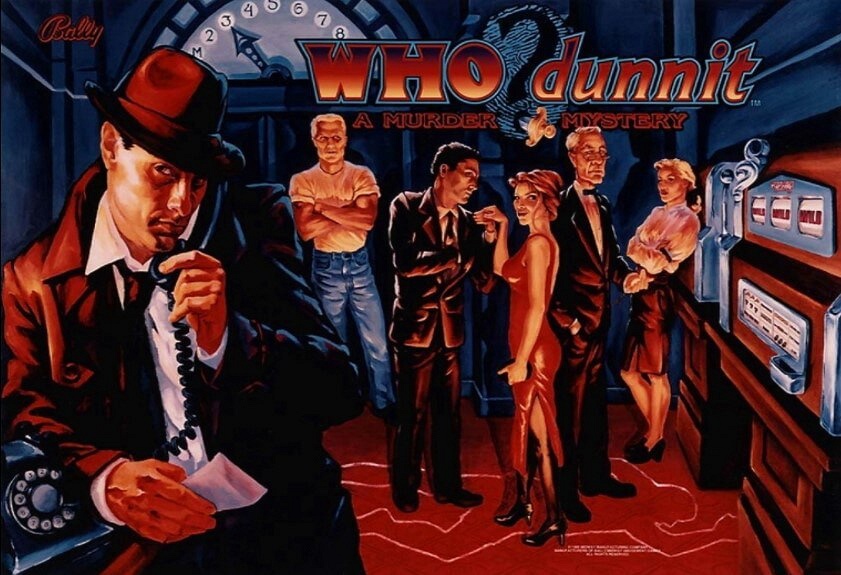
Who killed the victim? On Bally’s 1995 WHO dunnit, the answer is buried in a noir whodunit that doubles as one of the cleverest scoring puzzles of its era. Dwight Sullivan conceived and co-designed it with the legendary Barry Oursler, dressing the playfield with a working telephone toy and spinning slot-machine reels, and giving the whole machine the smoky, jazz-club atmosphere of a 1940s murder mystery. With 2,416 built, it’s a stylish, talky, atmospheric outlier that the cognoscenti adore.
The strategy here is delightfully sneaky. The headline trick is a multiball every ball: plunge the super skill shot to lock a ball, let the ball drain straight away for a fresh skill shot, and repeat — an exploit competitors lean on hard. The interrogation logic rewards deduction: the first time you question someone, either they or the person they name will be the correct suspect, intelligence you can spend either rushing to the Rooftop or amassing clues. Move between the building’s floors with the center shot, aiming for the seventh-floor Elevator Madness and its rich point haul. There’s even a midnight surprise — the game launches Midnight Madness multiball with every target worth three million — and a secret mania mode you can trigger by spamming the flippers past the third floor.
In tournament mode the machine becomes a game of memory and nerve: the roulette wheel alternates wins and losses starting with a loss, and the slot-spin awards run in a fixed, learnable order. WHO dunnit is a designer’s machine, dense with secrets and rhythm, and it rewards the player willing to study the case file. Crack the suspect, ride the elevator, and solve the murder one clue at a time.